
Summary of Hardkernel Launches A Single-unit Version Of Its 32-core Odroid-MC1 Cluster Computer
Hardkernel introduced the Odroid-MC1 Solo, a compact single-unit version of its 32-core Odroid-MC1 cluster computer. Designed for Docker Swarm and parallel computing, this octa-core board allows users to stack multiple units (from one to six or more) or combine them with the original four-unit MC1. It utilizes a stripped-down Odroid-XU4S SoC powered by a Samsung Exynos5422 processor, offering flexibility in building scalable clusters while maintaining compatibility with existing XU4-compatible Linux images.
Parts used in the Odroid-MC1 Solo:
- Odroid-XU4S SBC
- Samsung Exynos5422 SoC
- Mali-T628 GPU
- 2GB LPDDR3 RAM
- GbE port
- USB 2.0 host port
- MicroSD slot with UHS-1 support
- UART interface
- RTC with battery connector
- M3 x 8mm self-tapping screws
- Stacking case
Hardkernel has produced a single-unit version of its four-unit, 32-core Odroid-MC1 cluster computer for running Docker Swarm, Build Farm, and other parallel computing applications. The design offers greater flexibility for users to combine Odroid-MC1 Solo units for a “single unit, 2, 3, 4, 5, 6, or n stackable cluster”. The octa-core Odroid-MC1 Solo costs $48. Combing one or more Solo units with the original 4-unit MC1 acts as a single cluster.
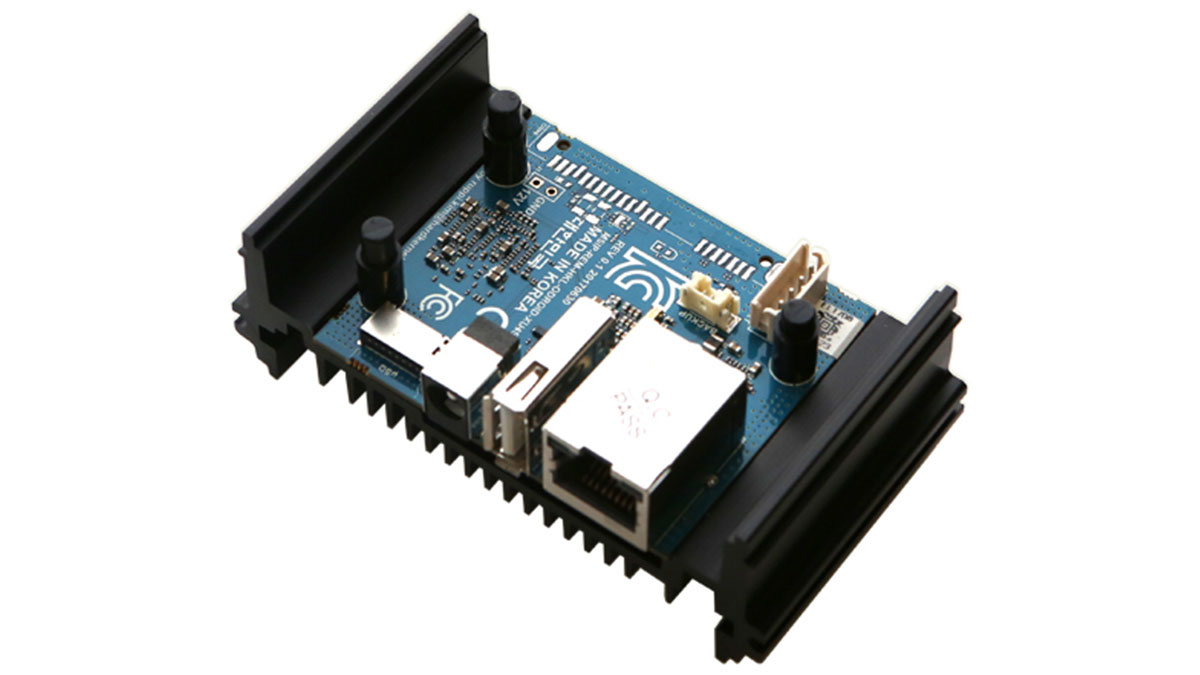
The Odroid-MC1 Solo and Odroid-MC1 use an Odroid-XU4S SBC that is similar to the SBC that powers the Odroid-HC2 network attached storage (NAS) device. Both boards are smaller, stripped-down, headless version of the open-spec Odroid-XU4 SBC.
Like the Odroid-HC2 board, the MC1 board has removed the XU4’s HDMI port, 2x USB 3.0 ports, optional eMMC, and 30- and 12-pin GPIO connectors. Like the Odroid-XU4, the boards are powered by the Samsung Exynos5422 SoC with four Cortex-A15, four Cortex-A7 cores, and Mali-T628 GPU.
All these boards are equipped with 2GB LPDDR3 (in a PoP configuration), as well as a GbE port, USB 2.0 host port, and a bootable microSD slot with UHS-1 support. The XU4s used on the Odroid-MC1 lacks the one additional feature found on the HC2 NAS computer that is a USB 3.0-based SATA port.
The new Odroid-MC1 Solo board, including the stacking case, measures 92 x 42 x 29mm. These boards are powered by a 5V/4A power supply. A UART, an RTC with battery connector, as well as “M3 x 8mm” self-tapping screws are also there on this board. The XU4-compatible Linux image is based on Kernel 4.14 LTS.
Key Specs:
- CPU Samsung Exynos5422 ARM® Cortex™-A15 Quad 2.0GHz/Cortex™-A7 Quad 1.4GHz
- DRAM Memory 2Gbyte LPDDR3 RAM PoP (750Mhz, 12GB/s memory bandwidth, 2x32bit bus)
- GPU Mali™-T628 MP6 OpenGL ES 3.1 / 3.0 / 2.0 / 1.1 and OpenCL 1.2 Full profile
- Micro-SD Slot UHS-1 compatible micro-SD slot up to 128GB/SDXC
- USB2.0 Host HighSpeed USB standard A type connector x 1 port
- LEDs Power, System-status
- Gbit Ethernet LAN 10/100/1000Mbps Ethernet with RJ-45 Jack ( Auto-MDIX support)
- Power Input DC Barrel Jack Socket 5.5/21.mm for 4.8V~5.2V input
- Size 92 x 42 x 29 mm
Read more: Hardkernel Launches A Single-unit Version Of Its 32-core Odroid-MC1 Cluster Computer
- What is the Odroid-MC1 Solo designed for?
It is designed for running Docker Swarm, Build Farm, and other parallel computing applications. - How many units can be stacked together?
Users can combine one or more Solo units to create a single unit, 2, 3, 4, 5, 6, or n stackable cluster. - Can the Solo unit work with the original MC1?
Yes, combining one or more Solo units with the original 4-unit MC1 acts as a single cluster. - Does the Odroid-MC1 Solo have an HDMI port?
No, the board has removed the HDMI port found on the standard Odroid-XU4. - What processor powers the Odroid-MC1 Solo?
The board is powered by the Samsung Exynos5422 SoC with four Cortex-A15 and four Cortex-A7 cores. - Is there a SATA port on the Odroid-MC1 Solo?
No, the XU4s used on the Odroid-MC1 lacks the USB 3.0-based SATA port found on the HC2 NAS computer. - What power supply does the board require?
The boards are powered by a 5V/4A power supply via a DC Barrel Jack Socket. - Which Linux kernel version is supported?
The XU4-compatible Linux image is based on Kernel 4.14 LTS.
