
Summary of HACKADAY PRIZE 2022: ARDUINO-POWERED WEIGHING SCALE HAS A REAL ANALOG DISPLAY
Miro Pavleski built a digital weighing scale that uses a traditional load cell and HX711 ADC with an Arduino Nano, but displays weight on a moving-coil analog meter with a custom kilogram dial. The scale uses a 100 g calibration routine and supports tare by placing containers before power-up, demonstrating calibration, nulling, and how modern scales convert strain-gauge signals to digital values yet present an analog readout.
Parts used in the Digital Weighing Scale with Analog Display:
- Load cell (strain-gauge based)
- Strain gauges wired as a Wheatstone bridge
- HX711 ADC/readout chip
- Arduino Nano microcontroller
- Moving-coil analog panel meter
- Custom printed kilogram background/dial for the meter
- Platform for weighing (mechanical support)
- 100 gram calibration weight (used for calibration)
- Power switch/button (for powering up and initiating tare/calibration)
- Wiring, connectors, and supporting hardware (mounts, screws)
Digital displays are useful for quick and accurate readout, but lots of people prefer the physical motion of a needle moving along a dial. For instance, many smartwatch users choose an analog face to show the time, and modern cars with digital dashboards often default to showing an analog speedometer. Following this trend, [Miro Pavleski] built a digital weighing scale with an analog display that not only looks neat, but also serves as a good demonstration of the way that modern scales work.
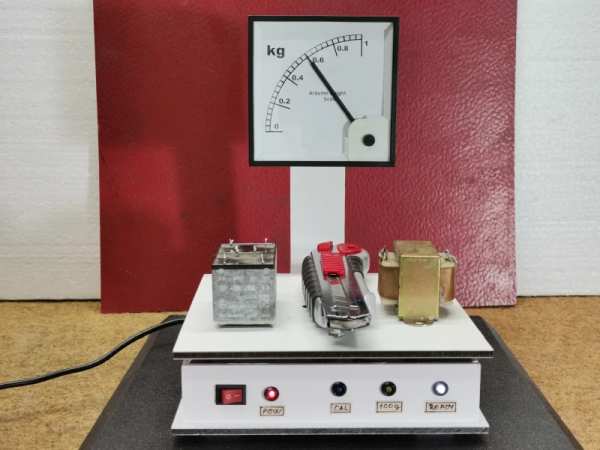
Inside, the device is built up like a typical electronic scale: the heart of the instrument is a load cell that supports the platform and bends in proportion to the weight applied. This bending motion is sensed by a set of strain gauges wired up in a Wheatstone bridge configuration. An HX711 readout chip measures the resulting voltage and converts it to a digital code that is sent to a microcontroller, in this case an Arduino Nano.
Whereas a typical scale would then simply show the resulting number on an LCD display, [Mirko] decided to use a moving coil meter driven by the Arduino’s analog output. That meter was originally designed to show currents, so [Mirko] printed a new background image using kilograms instead.
As with any analog sensor, calibration and nulling are essential to obtain a reliable measurement. When the instrument is powered up, it asks the user to place a 100 gram weight on the scale, which will then be used as a reference to control the voltage-to-weight scaling factor. You can also subtract the tare weight of any containers you might want to use by simply placing them on the platform before flipping the power button.
If you’re planning to design your own digital weighing scale, this older project is a great place to start. This teardown of a mass-produced scale is also full of interesting details. We’ve even seen a home-built scale that automatically weighs cats and feeds them based on ID.
Source: HACKADAY PRIZE 2022: ARDUINO-POWERED WEIGHING SCALE HAS A REAL ANALOG DISPLAY
- How does the scale sense weight?
Weight is sensed by a load cell that bends under load, with that bending measured by strain gauges arranged in a Wheatstone bridge. - What component converts the strain gauge signal to digital values?
The HX711 readout chip measures the bridge voltage and converts it to a digital code. - How is the digital code processed for display?
An Arduino Nano receives the digital code from the HX711 and drives the display output. - How is an analog display used with a digital scale?
The Arduino drives a moving-coil analog panel meter, and a custom kilogram dial was printed to match the meter to weight units. - How is the scale calibrated?
On power-up the device asks the user to place a 100 gram weight, which is used as the reference to set the voltage-to-weight scaling factor. - Can I tare the scale for containers?
Yes; you can place containers on the platform before powering up to subtract tare weight. - Why is nulling important?
Nulling and calibration are essential for reliable measurement because the analog sensor and electronics need zero and scale references. - Was the analog meter originally made for weight?
No; the moving-coil meter was originally designed to show currents and received a custom kilogram background.
