
Summary of How to hack EEG toys with arduino
This article details a DIY project converting a Star Wars Force Trainer toy into a functional EEG device for computer interface. The process involves opening the toy, soldering wires to specific internal pins (ground and "t"), drilling a case hole, connecting these wires to an Arduino, and using custom code to visualize brainwave data via Processing.
Parts used in the Force Trainer EEG Project:
- Arduino
- Star Wars Force Trainer toy
- Computer running Processing
- Arduino development environment
- Solid core wire
- Basic soldering supplies
- Zip ties
I was reminded of this for a project i wanted to do for a class (instructable coming soon ;-)), and i also found a “Star Wars force trainer” on amazon for 30 bucks.
Here is the simple step by step instructions on how to turn a force trainer into a working EEG you can see with your computer.
special thanks to frontier nerds for the initial code and the hack of a similar toy.

Step 1: What you’ll need
– Star Wars Force Trainer toy
– A computer running processing and the arduino development enviroment
– solid core wire
– basic soldering supplies
Step 2: Modding the Force Trainer
You’ll be looking for two spots, the ground and a pin labeled “t”. make sure the solder doesn’t get on any other pins and solder two wires, one from the ground and one from the t pin.
Once that is done, drill a small hold in the force trainer case and feed the wires through.
Step 3: Programming the arduino
Here is the code: Arduino Brain Library
Install that library and load the serial out example, verify you are getting data from the serial monitor.
Now you are ready to combine the arduino and the force trainer.
Step 4: Hooking up to the arduino
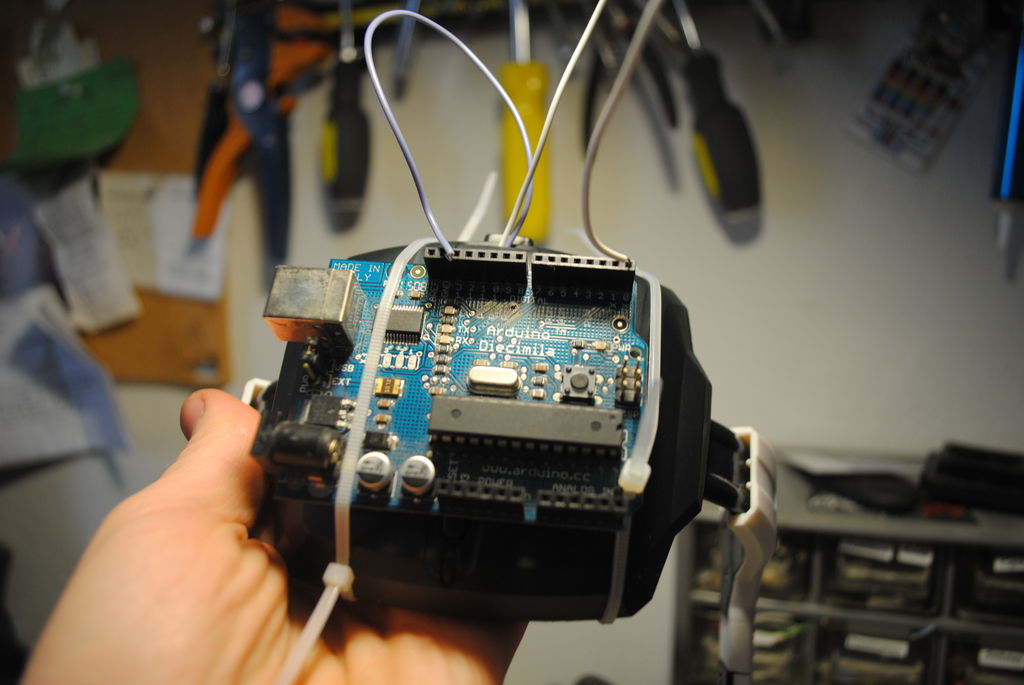
I used some zip ties to keep the arduino attached to the top of the force trainer.
- How can I turn a Force Trainer into a working EEG?
You must open the toy, solder wires to the ground and t pin, drill a hole for the wires, connect them to an Arduino, and run specific code. - What components are needed for this project?
The required items include an Arduino, the Star Wars Force Trainer toy, a computer with Processing and the Arduino IDE, solid core wire, and soldering supplies. - Where should I solder the wires on the Force Trainer?
You need to find the ground spot and a pin labeled t to solder the two wires without touching other pins. - Which Arduino pins do I use for the connections?
Connect the wire from the ground to GND on the Arduino and the wire from the t pin to pin 0 or RX. - Can I use any kind of Arduino for this hack?
Yes, the article states that any kind of Arduino will work for this project. - How do I verify the data is coming from the toy?
Install the Arduino Brain Library, load the serial out example, and check the serial monitor to verify you are getting data. - What software is required to see the data?
You need a computer running both Processing and the Arduino development environment. - How do I secure the Arduino to the toy?
The author used zip ties to keep the Arduino attached to the top of the Force Trainer.
