
Summary of FUEL GAUGES OFFER HIGHEST LEVEL OF BATTERY PROTECTION
The MAX17301 and MAX17311 are 1-cell battery fuel gauges featuring Maxim's ModelGauge m5 EZ algorithm for high state-of-charge accuracy without characterization. They offer low quiescent current (24μA active, 18μA hibernate) and SHA-256 authentication to prevent counterfeit batteries. These devices allow fine-tuning of voltage and current thresholds across temperature zones and include a unique secondary protection scheme that disables the battery in severe faults.
Parts used in the MAX17301/MAX17311 Fuel Gauge Project:
- MAX17301 device
- MAX17311 device
- ModelGauge m5 EZ algorithm
- SHA-256 authentication module
- Secondary protection scheme
- FETs
- Battery cell
- Temperature zones
Maxim’s MAX17301 and the MAX17311 1-cell fuel gauge devices allow fine tuning of voltage and current thresholds based on various temperature zones with a low quiescent current of 24μA
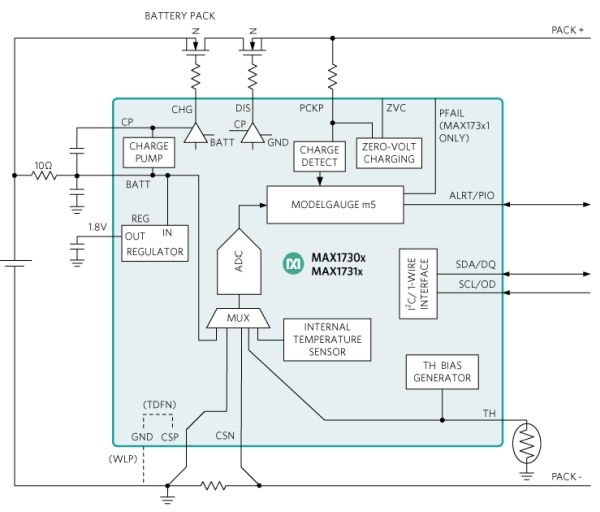
Maxim Integrated Products has developed a 1-cell battery fuel gauge that can provide counterfeit and cloning protection with low quiescent current.
The configurable setting in the MAX17301 and the MAX17311 allow fine tuning of voltage and current thresholds based on various temperature zones. These ICs also offer a first-of-its-kind secondary protection scheme in case the primary protection fails. This secondary protection scheme permanently disables the battery by overriding a secondary protector or blowing a fuse in severe fault conditions.
All the devices in the fuel gauge family are equipped with Maxim’s patented ModelGauge m5 EZ algorithm that delivers highest state-of-charge (SOC) accuracy that eliminates the need for battery characterization. These fuel gauges also have a quiescent current (IQ) of 24μA with the FETs enabled and 18µA in hibernate, up to 80 percent lower than the nearest competitor,
The devices also include SHA-256 authentication to safeguard the systems from counterfeit batteries.
Conventional battery protectors monitor voltage and current, and in some cases include temperature monitoring. These options make the system vulnerable to unexpected crashes because battery state-of-charge (SOC) isn’t factored in when triggering an undervoltage cut-off decision. There is a need for a simple, compact solution that protects from unsafe charging conditions that can lead to extensive battery damage including over-voltage, short circuit, over/under temperature and more.
While system and battery designers continue to push the limits of capacity-constrained batteries in order to provide the longest possible run-time without damaging the cell, there are few highly-configurable solutions that are still simple to implement. Designers are also looking for a way to protect the system by ensuring that only genuine batteries are used, which can eliminate unexpected shutdowns and crashes caused by potentially unsafe, counterfeit batteries.
Read more: FUEL GAUGES OFFER HIGHEST LEVEL OF BATTERY PROTECTION
-
How does the device protect against counterfeit batteries?
The devices include SHA-256 authentication to safeguard systems from counterfeit batteries. -
What is the quiescent current of these fuel gauges?
The quiescent current is 24μA with FETs enabled and 18μA in hibernate mode. -
Does the ModelGauge m5 EZ algorithm require battery characterization?
No, it delivers highest state-of-charge accuracy that eliminates the need for battery characterization. -
What happens if the primary protection fails?
A secondary protection scheme permanently disables the battery by overriding a secondary protector or blowing a fuse. -
Can users tune voltage and current thresholds based on temperature?
Yes, configurable settings allow fine tuning of voltage and current thresholds based on various temperature zones. -
Why do conventional battery protectors sometimes cause system crashes?
Conventional protectors often fail to factor in battery state-of-charge when triggering undervoltage cut-off decisions. -
What safety conditions can this solution protect against?
It protects from unsafe charging conditions including over-voltage, short circuit, and over/under temperature. -
How much lower is the quiescent current compared to competitors?
The quiescent current is up to 80 percent lower than the nearest competitor.
