
Summary of FT800 with Streaming Video on Gameduino 2
The author successfully streamed video from a vintage Connectix QuickCam to a Gameduino 2 equipped with an FT800 video processor. By writing a custom driver for the camera's parallel port interface, they demonstrated the concept of compositing motion video with other visual elements on the display, despite the camera's low image quality.
Parts used in FT800 with Streaming Video:
- Connectix QuickCam
- Gameduino 2
- FT800 video processor
- Parallel port interface
FT800 with Streaming Video
I like to check out the thrift stores in my area for one of a kind technical gems to add to my collection. A few years ago I came across a Connectix QuickCam. This is one of the earliest webcams that didn’t require a separate video capture card. Due to how easy it was to install, it was incredibly popular. So much so that Logitech ended up buying Connectix out and forking the product under their own brand.
When I saw it in the store I really had no idea what it was aside from the fact that it was a webcam and it had a parallel port. My first instinct was that a parallel port is simply a collection of TTL lines that I could emulate with a modern microcontroller. I finally had some time to put it into action and decided to stream video frames from the camera to a Gameduino 2 and the FT800 video processor that it uses.
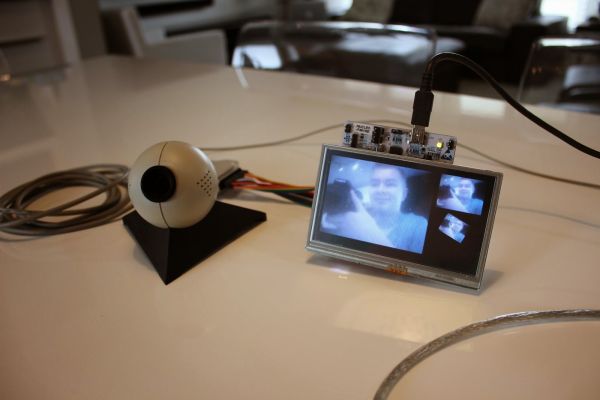
The results were great, aside from the low image quality of the camera. This experiment proves the concept of using an FT800 to composite motion video with other visual elements. A better image sensor would provide a really cool experience.
Keep reading to see how I did it!
The Camera
-
What was the main goal of this project?
To stream video frames from a webcam to a Gameduino 2 and prove the concept of using an FT800 to composite motion video with other visual elements. -
Which camera model was used in the experiment?
A Connectix QuickCam, which is one of the earliest webcams that did not require a separate video capture card. -
How did the author connect the camera to the microcontroller?
The author wrote a driver for the camera and utilized its parallel port, emulating it as a collection of TTL lines with a modern microcontroller. -
Why was the Connectix QuickCam considered popular?
It was incredibly popular due to how easy it was to install, eventually leading Logitech to buy Connectix out and fork the product under their own brand. -
What limitation was noted regarding the final results?
The results were great for proving the concept, but the image quality of the camera was low. -
Can a better sensor improve this setup?
Yes, the author states that a better image sensor would provide a really cool experience. -
Is the camera specification publicly available?
The original manufacturer documentation exists but is protected by an NDA, though it can be found through extensive searching.
