
Summary of FORCE FEEDBACK STEERING WHEEL MADE FROM POWER DRILL
Jason built a prototype force feedback steering wheel for racing games using spare parts to avoid high commercial costs. He used a high-torque motor and planetary gearbox from a battery-powered impact driver, an encoder salvaged from an old printer for position feedback, and an Arduino to interface with the game (sending controller data and receiving force feedback commands). The assembly was 3D printed and bench-mounted; initial tests show realistic torque effects but the motor-to-wheel coupling needs strengthening to prevent skipping or failure.
Parts used in the Force Feedback Steering Wheel:
- High-torque motor from a battery-powered impact driver
- Planetary gearbox integrated with the impact driver motor
- DC motor salvaged from an old printer (encoder used)
- Rotary encoder from an old printer
- Arduino microcontroller
- 3D printed case and mounting components
- Coupling mechanism between motor and steering wheel
- Work bench or mounting hardware to secure the wheel
- High-current circuitry associated with the impact driver motor
When it comes to controllers for racing games, there is perhaps no better option than a force feedback steering wheel. With a built-in motor to push against the wheel at exactly the right times, they can realistically mimic the behavior of a steering wheel from a real car. The only major downside is cost, with controllers often reaching many hundreds of dollars. [Jason] thought it shouldn’t be that hard to build one from a few spare parts though and went about building this prototype force feedback steering wheel for himself.
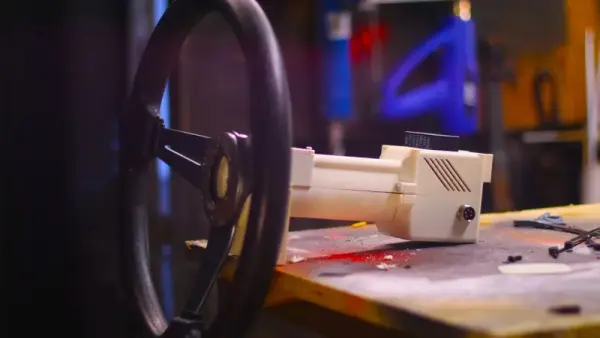
Sourcing the motor for the steering wheel wasn’t as straightforward as he thought originally. The first place he looked was an old printer, but the DC motor he scavenged from it didn’t have enough torque to make the controller behave realistically, so he turned to a high-torque motor from a battery-powered impact driver. This also has the benefit of coming along with a planetary gearbox as well, keeping the size down, as well as including its own high-current circuitry. The printer turned out to not be a total loss either, as the encoder from the printer was used to send position data about the steering wheel back to the racing game. Controlling the device is an Arduino, which performs double duty sending controller information from the steering wheel as well as receiving force feedback instructions from the game to drive the motor in the steering wheel.
After 3D printing a case for it and strapping it to a work bench, the initial tests proved to be promising. [Jason] can feel the motor from the power drill pushing against the steering wheel at the appropriate time. However there are some issues to work out with the prototype as the coupling mechanism between the motor and steering wheel isn’t strong enough to resist skipping and is likely to eventually break. We look forward to future videos when these issues are ironed out, but in the meantime we’d recommend taking a look at this force feedback mouse for other ways of making video game experiences more immersive.
Source: FORCE FEEDBACK STEERING WHEEL MADE FROM POWER DRILL
- What motor did Jason use to provide force feedback?
He used a high-torque motor from a battery-powered impact driver. - Was any part reused from a printer?
Yes, the encoder from an old printer was used for position feedback. - What handles the interface between the wheel and the game?
An Arduino performs controller reporting and receives force feedback commands from the game. - Did the printer motor work for force feedback?
No, the DC motor from the printer did not have enough torque for realistic feedback. - How was the housing for the prototype made?
The case was 3D printed. - Are there any issues with the prototype?
Yes, the coupling between the motor and steering wheel is not strong enough and can skip or risk breaking. - Does the impact driver provide any additional benefits?
Yes, it includes a planetary gearbox to keep size down and its own high-current circuitry. - How was the prototype mounted during testing?
It was strapped to a work bench for tests.
