
Summary of Find the right solder for you
This article explains how solder performance depends on both alloy composition and flux type, emphasizing that different applications require specific combinations. It highlights Stannol's extensive experience and product range, which includes universal types like HS10 and HF32 alongside specialized options for difficult surfaces. The text advises selecting solder based on detailed property analysis rather than just datasheets to ensure optimal spreading and minimal spitting during hand or machine soldering.
Parts used in the Solder Selection Project:
- Solder wire
- Flux
- Alloy (PbSn xx, SnAg xx)
- Stannol HS10
- Stannol HF32
- Stannol Kristall 400
- Stannol 2630
The solder matters, it is an undisputable fact confirmed daily in a development and production of electronics. Hand soldering of prototypes, automated machine soldering, soldering of small SMT components or on the in contrast soldering of big joints of massive connectors, rework, … all that wants a solder optimized for a given usage.
As we know, features of a solder wire are determined by an alloy itself (PbSn xx, SnAg xx, …) but in a considerable extent also a flux used. A flux has a big influence mainly on a soldering process, spreading of solder (often even on partially oxidized surfaces), spitting at hand soldering, etc. That´s why despite of often similar specification (according to datasheets), it is still possible to see considerable differences among solders after all. Besides the most important parameters like composition of alloy and flux properties, some features (like spitting and solder spreading) can be really evaluated only at working with a given type.
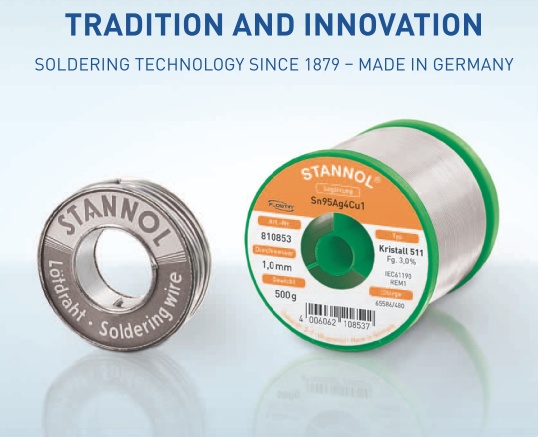
Over 130-years experience of German company Stannol give a guarantee, that in their portfolio can be found a type suitable even for your work. In a Stannol catalogue can be found favourite “universal” types suitable for the most types of works in electronics and electrotechnics (for example HS10, HF32, Kristall 400) but also specialized types suitable even for soldering of poorly solderable surfaces.
The principle of Stannol products marking is in it, that they are marked by a flux type (HS10, HF32,…) and by an alloy used (Snxx, SnPb,…). A solder wire is available in many combinations flux / alloy , that´s why it is suitable look at their properties in detail and then to choose a suitable type. On stock we keep the most favorite types with fluxes HS10, HF32 or 2630, suitable for majority of joints.
For more Details: Find the right solder for you
- What determines the features of a solder wire?
The alloy itself and the flux used determine solder wire features. - How does flux influence the soldering process?
Flux significantly affects the soldering process, solder spreading on oxidized surfaces, and spitting during hand soldering. - Can solder spreading be evaluated using only datasheets?
No, features like spitting and solder spreading can often only be evaluated by working with a given type. - Which Stannol types are considered universal?
Favourite universal types include HS10, HF32, and Kristall 400 suitable for most electronics work. - How are Stannol products marked?
Products are marked by a flux type followed by an alloy used, such as Snxx or SnPb. - Which fluxes are kept on stock for majority of joints?
The most favorite types with fluxes HS10, HF32, or 2630 are kept on stock for the majority of joints.
