
Summary of EXTREMELY COMPACT BREADBEE HAS 1GHZ ARM CORTEX-A7 SBC AND ON-BOARD ETHERNET
Palmer’s BreadBee is a 32 x 30 mm Linux-capable single-board computer built around an MSC313E ARM Cortex-A7 SoC (1 GHz), designed for integration into hobbyist projects and IP-camera applications. Despite its tiny footprint, it offers DDR2 memory, Ethernet, multiple serial and peripheral interfaces, ADCs, PWM, RTC/watchdog, and bootable SPI-NOR storage.
Parts used in the BreadBee:
- MSC313E ARM Cortex-A7 SoC (single-core, 1 GHz)
- 64kB static RAM
- 64MB DDR2 memory
- Ethernet PHY supporting 100 Mbit Ethernet
- SPI-NOR flash for bootable and memory-mapped storage
- ADC subsystem providing 4x 10-bit ADC channels
- SPI interfaces (2x SPI)
- I2C interface (1x I2C)
- UART interfaces (3x UARTs)
- General Purpose Input/Output pins (multiple GPIOs)
- PWM outputs (8x PWM pins)
- Real-Time Clock (RTC)
- Watchdog timer
- USB PHY with host/device multiplexer
- SD / SDIO interface
- QFN package PCB footprint (approximately 32 mm x 30 mm)
Measuring about 32 x 30 mm in footprint, Palmer’s fully-functional development board is a very small Linux-based single-board computer built around an ARM Cortex A7 SoC and targets IP cameras.
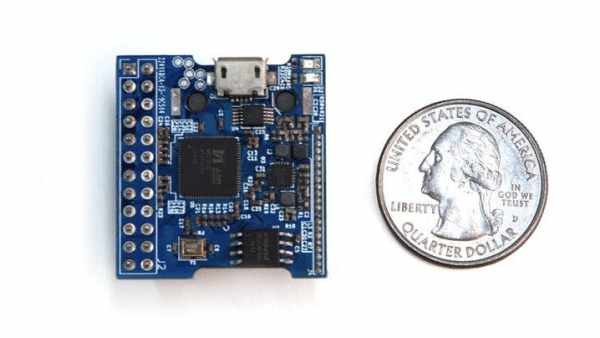
There are no solutions yet that can run a real OS like Linux that can be integrated by hobbyists into boards from cheap PCB vendors that don’t have show-stopping limitations. The BreadBee is based on a relatively unknown IP camera SoC, the MSC313E, from a company called MStar. You might have never heard of MStar but you probably have one of their chips on your TV. The MSC313E has just enough of the usual microcontroller peripherals to make it useful, comes in a (relatively) easy to work with QFN package, is tiny, and costs $4. It is a bit harder to integrate into your designs than a microcontroller that requires a single power supply but all of the information you would need to do so is right here
explains Palmer as he prepares to launch a crowdfunding campaign for his new design.
The single-board computer, he said, is one that can be integrated into any project while reserving considerable space. Despite its very small form factor, BreadBee boasts of certain impressive specifications which include:
- Single-core Arm Cortex A7 SoC running at 1GHz
- 64kB static RAM and 64MB of DDR2 memory
- 100 Mbit Ethernet
- Bootable and memory-mapped SPI-NOR
- 4x 10bit ADC channels
- 2x SPIs, 1x 12C
- 3 x UARTs
- Quite a lot of GPIOs
- 8x PWM pins
- Real-Time Clock and Watchdog timer.
- USB PHY and host/device mux
- SD / SDIO interface
- 32mm x 30 mm in size
Read more: EXTREMELY COMPACT BREADBEE HAS 1GHZ ARM CORTEX-A7 SBC AND ON-BOARD ETHERNET
- What is the processor used in the BreadBee?
The BreadBee uses an MSC313E single-core ARM Cortex-A7 SoC running at 1 GHz. - Can the BreadBee run Linux?
Yes, the BreadBee is Linux-capable and designed to run a real OS like Linux. - What memory does the BreadBee include?
It includes 64kB static RAM and 64MB of DDR2 memory. - Does the BreadBee have Ethernet connectivity?
Yes, it provides 100 Mbit Ethernet connectivity. - What kinds of storage and boot options are available?
It supports bootable and memory-mapped SPI-NOR flash. - How many ADC channels does the BreadBee provide?
The board provides 4 channels of 10-bit ADC. - What serial and peripheral interfaces are available?
It offers 2 SPI interfaces, 1 I2C interface, 3 UARTs, SD/SDIO, and USB PHY with host/device mux. - Does the BreadBee include PWM and GPIO capabilities?
Yes, it has quite a lot of GPIOs and 8 PWM pins. - Is there an RTC and watchdog on the BreadBee?
Yes, the design includes a real-time clock and a watchdog timer. - What is the physical size of the BreadBee board?
The board measures approximately 32 mm by 30 mm.
