
Summary of EXPORTING DATA FROM OLD GEAR THROUGH LCD SNIFFING
[Jure Spiler] hacked a 25-year-old spectrophotometer to export data by sniffing its graphical LCD interface. After decoding display signals with a logic analyzer and custom software, he aimed to create a standalone device for computer storage. Although an Arduino failed to meet the required 1 MHz readout speed, he discovered an undocumented serial output on the expansion port and is now investigating that alternative method instead of continuing with the LCD approach.
Parts used in the Spectrophotometer Data Export Project:
- Spectrophotometer (25-year-old model)
- PC-1206B Graphical LCD Display
- 16-channel Logic Analyzer
- Decoder Software
- Arduino Microcontroller
- Sped-up GPIO Library
- Spectrophotometer Expansion Port
[Jure Spiler] was at a flea market and got himself a spectrophotometer — a device that measures absorbance and transmittance of light at different wavelengths. This particular model seems to be about 25 years old, and it’s controlled by a built-in keyboard and uses a graphical LCD to display collected data. That might have been acceptable when it was made, but it wasn’t enough for [Jure]. Since he wanted to plot the spectrophotometry data and be able to save it into a CSV file, hacking ensued.
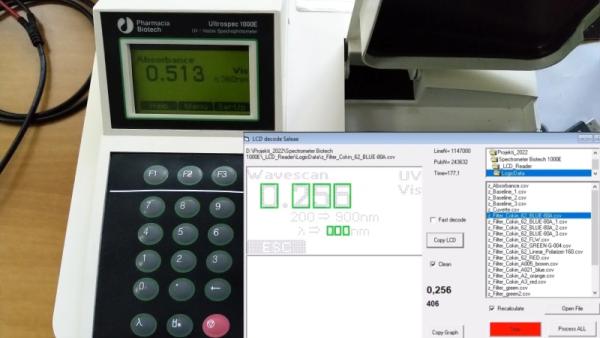
He decided to tap into the the display communication lines. This 128×64 graphical display, PC-1206B, uses a 8-bit interface, so with a 16-channel logic analyzer, he could see the data being sent to the display. He even wrote decoder software – taking CSV files from the logic analyzer and using primitive optical recognition on the decoded pixels to determine the digits being shown, and drawing a nice wavelength to absorbance graph. From there, he set out to make a standalone device sniffing the data bus and creating a stream of data he could send to a computer for storage and processing.
[Jure] stumbled into a roadblock, however, when he tried to use an Arduino for this task. Even using a sped-up GPIO library (as opposed to notoriously inefficient digitalRead), he couldn’t get a readout frequency higher than 80 KHz – with the required IO readout rate deemed as 1 MHz, something else would be called for. We do wonder if something like RP2040 with its PIO machinery would be better for making such captures.
At that point, however, he found out that there’s undocumented serial output on one of the pins of the spectrophotometer’s expansion port, and is currently investigating that, having shelved the LCD sniffing direction. Nevertheless, this serves as yet another example for us, for those times when an LCD connection is all that we can make use of.
We’ve seen hackers sniff LCD interfaces to get data from reflow ovens, take screenshots from Game Boys and even equip them with HDMI and VGA ports afterwards. With a skill like this, you can even give a new life to a vintage calculator with a decayed display! Got an LCD-equipped device but unsure about which specific controller it uses? We’ve talked about that!
Source: EXPORTING DATA FROM OLD GEAR THROUGH LCD SNIFFING
-
What problem did Jure face when trying to use an Arduino?
The Arduino could not achieve the required 1 MHz IO readout rate, maxing out at only 80 KHz even with a sped-up GPIO library. -
How did Jure initially attempt to capture data from the device?
He tapped into the display communication lines using a 16-channel logic analyzer to observe the 8-bit interface data sent to the PC-1206B screen. -
What software solution was created to process the captured signals?
Jure wrote decoder software that took CSV files from the logic analyzer and used primitive optical recognition to identify digits and draw graphs. -
Why was the original LCD sniffing approach shelved?
The project was paused because an undocumented serial output was found on one of the pins of the spectrophotometer's expansion port. -
What specific type of display was analyzed in this project?
A 128×64 graphical display identified as the PC-1206B model which uses an 8-bit interface. -
What alternative hardware might have been better suited for the capture task?
The article suggests that an RP2040 microcontroller with its PIO machinery would likely be better for making such high-speed captures than the Arduino. -
What was the ultimate goal of hacking the spectrophotometer?
The goal was to plot spectrophotometry data and save it into a CSV file for storage and processing on a computer.
