
Summary of EMB-2237-AI – PICO-ITX POE EDGE AI EMBEDDED BOARD WITH NXP I.MX8M MINI ARM PROCESSOR
The EMB-2237-AI is a compact PoE edge AI embedded PICO-ITX board built around NXP i.MX8M Mini processors, offering long lifecycle support and interfaces for industrial machine learning, embedded vision, and inferencing. It supports Edge TPU/VPU accelerator modules via M.2, provides PoE (IEEE 802.3af), integrated multi-display single FPC touch connector, on-board voice control with dual-core DSP and Linux voice SDK support, and industrial serial interfaces for robust edge AI deployments.
Parts used in the EMB-2237-AI:
- NXP i.MX8M Mini application processor
- PICO-ITX form factor embedded board
- RJ45 Ethernet port with PoE (IEEE 802.3af) power module
- M.2 slot for TPU/VPU accelerator modules (e.g., Coral Edge TPU)
- Single FPC connector integrating 4-lane MIPI DSI
- Dual-channel LVDS interface (via FPC)
- RGB display interface (via FPC)
- Backlight control and touch panel interface (via FPC)
- On-board smart audio codec with dual-core DSP
- 40-pin expansion header with 8-channel digital audio/DMIC (SAI5)
- RS-485 serial interface
- RS-232 serial interface
Built For Edge AI Applications
Targeted to satisfy diverse applications demanding a robust and compact computing POE edge AI embedded board for industrial machine learning, embedded vision and inferencing, the board is based on NXP application processors with 10+ year longevity support, built-in reliable communication interfaces like RS-485, RS-232 and M.2 slot for support of TPU, VPU accelerator modules like Google Coral Edge TPU and others.
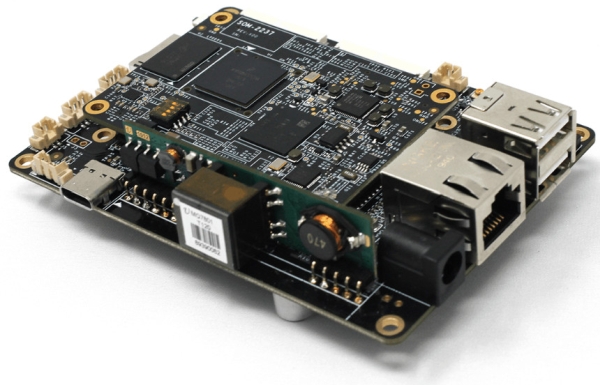
PoE Power Module
Provides on-board Power over Ethernet (PoE) IEEE 802.3af standards power input via RJ45 Ethernet port for the board and system to make installing or large roll-out much simpler and cheaper
Single Point Touch Screen Connector
Integrates 4-lane MIPI DSI, dual Channel LVDS, RGB, power, backlight control and touch panel interface all in one FPC connector to give developers fast, convenient and simplified solutions for industrial and embedded POE touch panel PC applications.
The EMB-2237-AI POE edge AI embedded board takes the advantage of the latest NXP i.MX8MM application processors with scalable computing platforms and 15 years long life cycle support. It is designed to support Edge TPU, VPU machine learning accelerator modules and provides a solid base for your edge AI computer designs in areas like Human Machine Interface (HMI), voice control, machine vision, building automation and industrial AI.
On-Board Voice Control Support
Built-in smart codec with dual-core DSP that runs algorithms for voice control, omni-directional spatial, noise suppression, and acoustic echo cancellation (AEC). Linux supports for Amazon AVS (Alexa Voice Service) Device SDK and Sensory TrulyHandsfree Wake Word Engine. Additional 8 channel digital audio/DMIC inputs (SAI5) for MIC array is also available via 40-pin expansion header.
Read more: EMB-2237-AI – PICO-ITX POE EDGE AI EMBEDDED BOARD WITH NXP I.MX8M MINI ARM PROCESSOR
- What processor does the EMB-2237-AI use?
It uses NXP i.MX8M Mini application processors. - Does the board support PoE?
Yes, it provides on-board Power over Ethernet via RJ45 following IEEE 802.3af. - Can I add an AI accelerator to the EMB-2237-AI?
Yes, it has an M.2 slot to support TPU and VPU accelerator modules like the Google Coral Edge TPU. - What display interfaces are available on the board?
It integrates 4-lane MIPI DSI, dual-channel LVDS, and RGB via a single FPC connector with backlight and touch support. - Does the board support voice control?
Yes, it includes an on-board smart codec with a dual-core DSP for voice control, noise suppression, and AEC, and Linux support for Amazon AVS and Sensory TrulyHandsfree. - Are industrial serial ports provided?
Yes, the board includes RS-485 and RS-232 interfaces. - Is there support for microphone arrays?
Yes, there are 8-channel digital audio/DMIC inputs (SAI5) available via the 40-pin expansion header. - What applications is the EMB-2237-AI targeted for?
It is targeted for industrial machine learning, embedded vision, inferencing, HMI, voice control, machine vision, building automation, and industrial AI.
