
Summary of ELECTRIC WHEELCHAIR MAKES A GREAT BASE FOR A BIG ROBOT
This article describes repurposing a broken electric wheelchair into a large-scale robot base. The project, started in 2009 by [Nikita], utilized a $50 wheelchair to acquire a robust chassis, wheels, motors, and controllers. The original joystick was relocated for manual driving, while an Arduino enabled radio control. Additional features include "eyes" for personality, with future plans for autonomous navigation and face recognition using modern technology.
Parts used in the Electric Wheelchair Robot:
- Electric wheelchair
- Robust chassis
- Wheels
- Motors
- Controllers
- Arduino
- Radio control system
- Eyes (visual sensors)
- Original joystick
Building robots can be fun, and remains a popular pastime among many in the hacker and maker set. However the hardware side of things can be daunting. This is particularly the case for those attempting to build something on a larger scale. A great shortcut is to start with a robust mechanical platform from the outset – and using an electric wheelchair is a great way to do so.
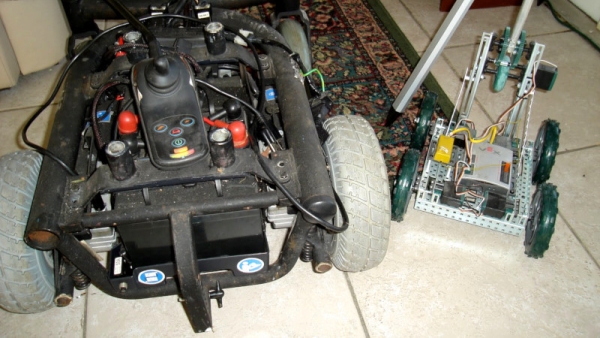
[Nikita] started this project way back in 2009, after finding a broken electric wheelchair at a flea market. It was no longer in fit condition for use as a wheelchair, so [Nikita] was able to score it for the low price of just $50. That’s a great price for a package which includes a robust chassis, wheels, motors and the required controllers to drive it all. With the platform in hand, it was time to get hacking.

Thus far, [Nikita] has gone so far as to strip the wheelchair of all extraneous parts, leaving it as a motorized carriage. Radio control has been implemented with the help of an Arduino, and a couple of “eyes” have been added to give it a little personality. It can also still be driven with the original joystick, which has been relocated on the chassis. Future plans involve adding a level of autonomy to allow the ‘bot to navigate waypoints and recognise faces, both tasks which should be significantly easier with 2019 technology. We’re eager to see where it goes next; we’ve seen great applications of wheelchair hardware before, after all. Video after the break.
Source: ELECTRIC WHEELCHAIR MAKES A GREAT BASE FOR A BIG ROBOT
- Why is an electric wheelchair a good choice for a robot project?
It provides a robust mechanical platform including a chassis, wheels, motors, and controllers at a low cost. - How much did the wheelchair cost in this project?
The broken wheelchair was purchased for just $50 at a flea market. - What hardware components were stripped from the wheelchair?
All extraneous parts were removed, leaving only the motorized carriage structure. - How is radio control implemented in the robot?
An Arduino is used to implement the radio control functionality. - Can the robot still be driven manually?
Yes, the original joystick has been relocated on the chassis for manual driving. - What visual feature was added to give the robot personality?
A couple of eyes were added to the robot. - What are the future plans for the robot's autonomy?
Plans involve adding autonomy to navigate waypoints and recognize faces. - When did the project start?
[Nikita] started this project way back in 2009.
