
Summary of DIY ARDUINO BASED EV CHARGER SAVES MONEY, LOOKS PRO
This article details [fotherby]'s DIY 7.2 kW EV charger project for his Kia, designed to save money compared to commercial units. The build utilizes an Arduino Pro Mini for control and includes a ground fault detection circuit for safety. The project emphasizes understanding charger mechanics and meeting commercial standards through rigorous testing, though it is recommended only for experienced enthusiasts due to high-voltage risks.
Parts used in the 7.2 kW EV Charger:
- Commercial enclosure
- Cable (showroom unit)
- Arduino Pro Mini
- Ground fault detection circuit
Electric vehicles (EVs) are something of a hot topic, and most of the hacks we’ve featured regarding them center on conversions from Internal Combustion to Electric. These are all fine, and we hope to see plenty more of them in the future. There’s another aspect that doesn’t get covered as often: How to charge electric vehicles- especially commercially produced EV’s rather than the DIY kind. This is the kind of project that [fotherby] has taken on: A 7.2 kW EV charger for his Kia.
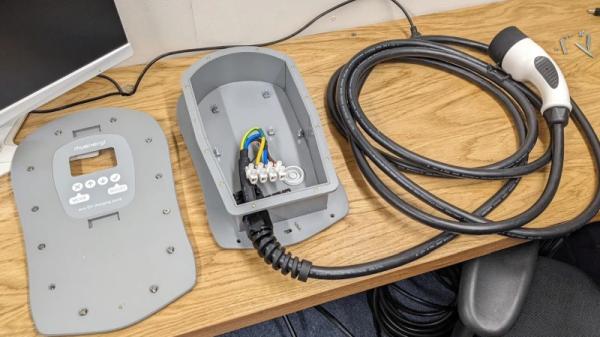
Faced with spending £900 (about $1100 USD) for a commercial unit installed by a qualified electrician, [fotherby] decided to do some research. The project wasn’t outside his scope, and he gave himself a head start by finding a commercial enclosure and cable that was originally just a showroom unit with no innards.
An Arduino Pro Mini provides the brains for the charger, and the source code and all the needed information to build your own like charger is on GitHub. What’s outstanding about the guide though is the deep dive into how these chargers work, and how straightforward they really are without being simplistic.
Dealing with mains power and the installation of such a serious piece of kit means that there are inherent risks for the DIYer, and [fotherby] addresses these admirably by including a ground fault detection circuit. The result is that if there is a ground fault of any kind, it will shut down the entire circuit at speeds and levels that are below the threshold that can harm humans. [fotherby] backs this up by testing the circuit thoroughly and documenting the results, showing that the charger meets commercial standards. Still, this isn’t a first-time project for the EV enthusiast, so we feel compelled to say “Don’t Try This At Home” even though that’s exactly what’s on display.
In the end, several hundred quid were saved, and the DIY charger does the job just as well as the commercial unit. A great hack indeed! And while these aren’t common, we did cover another Open Source EV charger about a year ago that you might like to check out as well.
Source: DIY ARDUINO BASED EV CHARGER SAVES MONEY, LOOKS PRO
- Why did [fotherby] build a DIY EV charger?
To avoid spending £900 on a commercial unit installed by a qualified electrician. - What provides the brains for this charger?
An Arduino Pro Mini serves as the controller for the system. - Where can I find the source code for this project?
The source code and necessary information are available on GitHub. - How does the charger ensure safety against ground faults?
A ground fault detection circuit shuts down the entire circuit below harmful thresholds. - Does the DIY charger meet commercial standards?
Yes, thorough testing documented by [fotherby] shows it meets these standards. - Is this project suitable for first-time builders?
No, the author states this is not a first-time project due to inherent risks. - How much money was saved by building this charger?
Several hundred quid were saved compared to buying a commercial unit.
