
Summary of digitally controlled HiFi Amp with 4 way mixer
The author upgrades a homebuilt TDA1554Q stereo amplifier to support four audio sources and digital volume control. The project enables remote volume adjustment via smartphone, addressing the need for a multi-input desktop sound system that serves as a radio, movie, and podcast player without manual knob turning.
Parts used in the Digitally Controlled HiFi Amp:
- TDA1554Q IC
- Aluminum box
- Resistors
- Capacities
- Digital potentiometers
- Fixed resistor
- Linear potentiometer
Motivation
Though I am a musician I don’t care for calling an expensive hi watt stereo my own. For years I have used a homebuilt stereo amplifier built around the TDA1554Q IC (basically just this chip in a nice box) and I am still very happy with the sound quality. This amp serves as a computer desk sound system, which acts as a radio/movie sound sytem as well.
In the meantime the number of sound sources that I want to connect to my “stereo” has increased … suddenly there was a tablet that I use as an internet radio, a music player demon that runs on a raspberry pi and from time to time I want to listen to a podcast that I downloaded to my smartphone.
So a next-gen desktop stereo should have multiple inputs … about four of them would be nice. Also when watching TV on my computer from the bed I don’t want to get up all the time if I just want to adjust the volume. I’d like to do it digitally … maybe use my smart phone as a remote control?
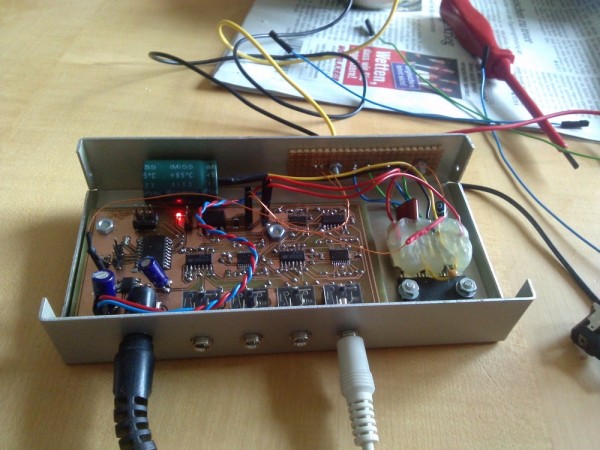
Let’s summarize:
- 20 W stereo power amplifier
- 4 way audio in
- digital volume control interface
Approach
The amplifier section is trivial. You just buy a TDA1554Q, bolt it to the inside of an aluminum box, solder some resistors and capacities to the pins of the IC according to the application note in the datasheet and you have a small HiFi amplifier.
Because the volume control has to be digital, I’m using digital potentiometers. Sadly there are no (affordable) logarithmic digipots available. However I found this method which employs a linear potentiometer in combination with a fixed resistor to “fake” a logarithmic potentiometer.
For More Details: digitally controlled HiFi Amp with 4 way mixer
- Why did the author upgrade the existing amplifier?
The number of sound sources increased, requiring multiple inputs and digital volume control. - What power output does the new stereo system provide?
The system provides 20 W stereo power. - How many audio inputs does the next-gen desktop stereo have?
The design includes about four audio inputs. - Can users adjust the volume digitally instead of manually?
Yes, the project uses a digital volume control interface controlled by a smartphone. - What chip is used for the amplifier section?
The TDA1554Q integrated circuit is used for the amplifier. - Are affordable logarithmic digital potentiometers available?
No, there are no affordable logarithmic digipots available. - How is a logarithmic response achieved with linear components?
A linear potentiometer is combined with a fixed resistor to fake a logarithmic potentiometer. - What devices can connect to this stereo system?
Tablets, Raspberry Pi music players, and smartphones can connect as sources.
