
Summary of D.I.Y Pneumatic Linear Actuators
The article details a DIY project creating cost-effective pneumatic linear actuators using compressed air instead of electric motors. The author built custom cylinders from common hardware and designed a simple optical encoder with an Arduino to track movement, achieving lower costs than commercial alternatives.
Parts used in the D.I.Y Pneumatic Linear Actuators:
- CPVC tubing
- CPVC primer and cement
- Silicone caulk
- Steel rod
- Quick fittings for 1/4″ o.d. tubing
- Teflon tape
- Pneumatic oil
- L.E.D.
- Photo-resistor
- Desktop printer Illustrator image of evenly spaced 3mm lines alternating black to white
- Arduino
- Solenoid switches (commercial)
The D.I.Y. movement has many implications for the future of creativity and commerce. The impact of inventing what one needs rather than purchasing it promises to be empowering, fun, and inspirational. In a long term effort to develop dynamic computer controlled surfaces, I began exploring fluid control (in this case, compressed air) as an alternative to electric motor driven actuators. The hypothesis was that the expense, both in electricity and dollars, would be less as the system scaled up. While the expense calculation has not taken into account the processes of compressing and shipping air supply tanks, suffice to say the unit cost of each actuator was less than electric motors (with equivalent force) and less than 1/5 the cost of a commercial pneumatic cylinder (with required hardware for computer control).
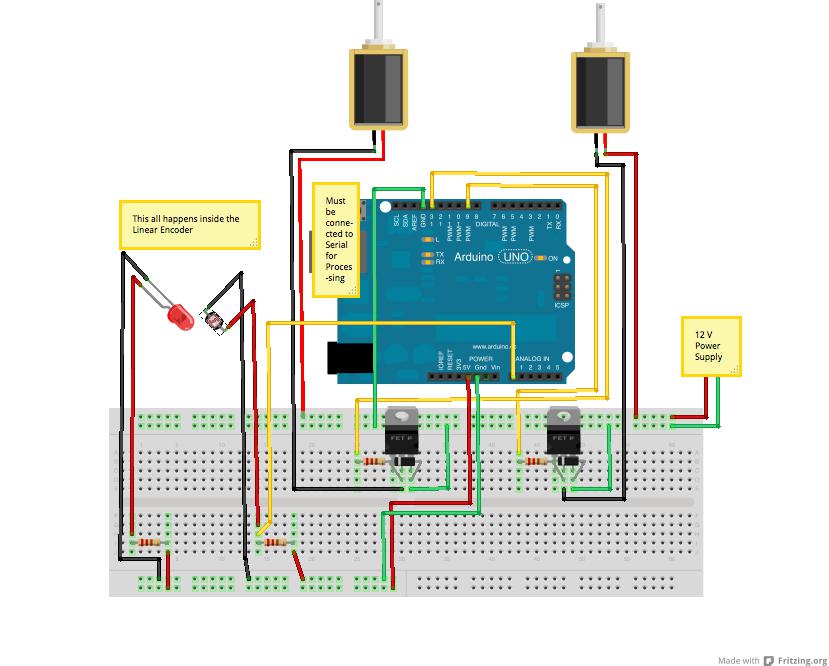
In addition to a D.I.Y air cylinder, I examined the function of commercial linear encoders and decided to build one which could be custom-housed to follow the movement of the cylinder. The final design is clearly visible in the video above. The encoder hardware is quite simple. A L.E.D is aimed toward a photo-resistor, 45 degrees to the plane of the encoder strip and 90 degrees to each other. The encoder strip was a desktop printer Illustrator image of evenly space 3mm lines alternating black to white.
The software was run through Arduino. It “looked” for value changes in the photo-resisitor readings and counted the stripes as they passed by. (Full code in the appendix)
The cylinders themselves were constructed of common hardware items including, CPVC tubing, CPVC primer and cement, silicone caulk, steel rod, quick fittings for 1/4″ o.d. tubing, Teflon tape and a little pneumatic oil.
The only hardware necessary to put them together was a saw, a crecent wrench, something to cut the steel ( I recommend a 41/2″ grinder with a cutoff wheel!) a drill or drill press and a top to match the threads of the quick fittings. (Full assembly instructions to follow…)
Once a cylinder was assembled, it was tested with compressed air.
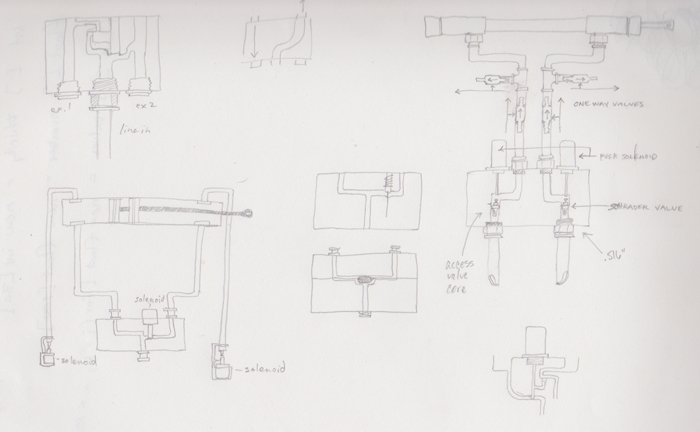
The component I didn’t personally develop was the switching system comprised commercially of solenoid switches. There was a logical reason for this. Commercial multi-directional solenoid switches are generally regarded as SUPER high tech engineering and manufacturing. After a couple of weeks of vacillating and only coming up with this:
For more detail: D.I.Y Pneumatic Linear Actuators
- Why did the author choose compressed air over electric motors?
The hypothesis was that the expense in electricity and dollars would be less as the system scaled up. - How much cheaper are these DIY actuators compared to commercial ones?
The unit cost is less than electric motors with equivalent force and less than 1/5 the cost of a commercial pneumatic cylinder. - What components make up the custom encoder strip?
The strip consists of an L.E.D. aimed at a photo-resistor and a desktop printer image of evenly spaced 3mm lines alternating black to white. - How does the software track the cylinder movement?
The Arduino looks for value changes in the photo-resistor readings and counts the stripes as they pass by. - What tools are required to assemble the cylinders?
You need a saw, a crescent wrench, a grinder with a cutoff wheel, a drill or drill press, and a top to match the quick fitting threads. - Why were solenoid switches not built personally?
Commercial multi-directional solenoid switches are regarded as super high tech engineering and manufacturing. - What fluid control method was explored as an alternative to electric actuators?
The author explored fluid control using compressed air. - Can the expense calculation include compressing and shipping air supply tanks?
No, the expense calculation has not taken into account the processes of compressing and shipping air supply tanks.
