
Summary of Controlling Multiple Servo Motors with Arduino
This article explains how to control multiple servo motors using an Arduino UNO. It highlights that connecting all servos directly to the Arduino's power pins causes current shortages, necessitating a separate external power supply like a 5V adapter or 9V battery. The text details servo wiring (Red for power, Black for ground, Yellow for signal) and describes how PWM duty ratios determine shaft position via the signal pin.
Parts used in the Multiple Servo Motors with Arduino Project:
- Arduino UNO
- Servo Motor
- Power Supply
- Breadboard
- Connecting Wires
Using one or two Servo with Arduino is Easy but what if we want to use more than one Servo Motors?
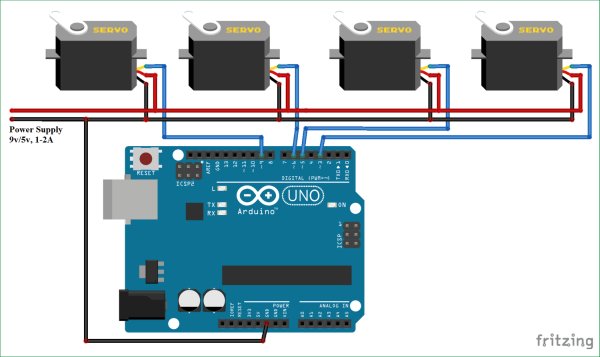
Here, we are going to show you that how to control Multiple Servo Motors with Arduino. Connecting multiple Servo Motors with Arduino seems to be easy and but if we connect all the Servos to Arduino supply pins then they won’t work correctly because of lack of enough current to drive all the motors. So you have to use separate power supply for the motors, either it be from some adapters (5v 2A) or from good quality 9v batteries.
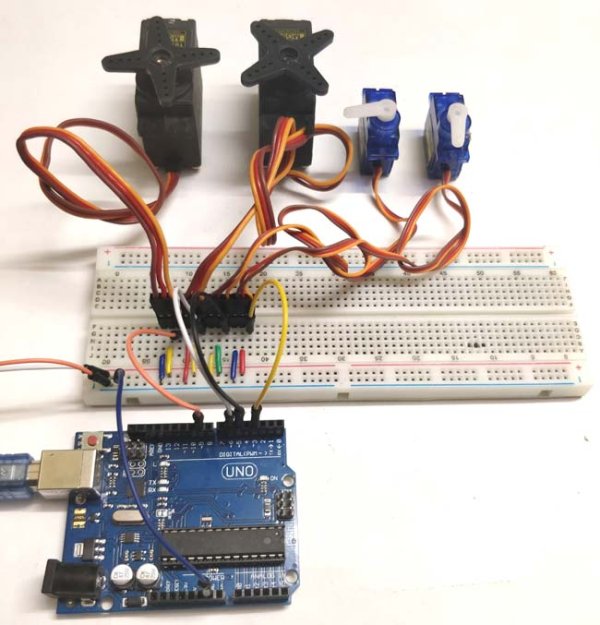
Material Required
- Arduino UNO
- Servo Motor
- Power Supply
- Breadboard
- Connecting Wires
Circuit Diagram
What is a Servo Motor?
Before going into detail, first we should know about Servo Motors.
Servo motors are available at different shapes and sizes. A servo motor will have mainly there wires, one is for positive voltage another is for ground and last one is for position setting. The RED wire is connected to power, Black wire is connected to ground and YELLOW wire is connected to signal.
A servo motor is a combination of DC motor, position control system, gears. The position of the shaft of the DC motor is adjusted by the control electronics in the servo, based on the duty ratio of the PWM signal the SIGNAL pin.
Simply speaking the control electronics adjust shaft position by controlling DC motor. This data regarding position of shaft is sent through the SIGNAL pin. The position data to the control should be sent in the form of PWM signal through the Signal pin of servo motor.
The frequency of PWM (Pulse Width Modulated) signal can vary based on type of servo motor. The important thing here is the DUTY RATIO of the PWM signal. Based on this DUTY RATION the control electronics adjust the shaft.
As shown in figure below, for the shaft to be moved to 9o clock the TURN ON RATION must be 1/18.ie. 1ms of ON time and 17ms of OFF time in a 18ms signal.
Read more: Controlling Multiple Servo Motors with Arduino
- Why can't I connect multiple servos directly to Arduino supply pins?
They will not work correctly because of a lack of enough current to drive all the motors. - What is the best way to power multiple servo motors?
You must use a separate power supply such as 5v 2A adapters or good quality 9v batteries. - How many wires does a standard servo motor have?
A servo motor mainly has three wires for positive voltage, ground, and position setting. - Which color wire connects to the power source?
The RED wire is connected to power. - What happens if the BLACK wire is connected incorrectly?
The BLACK wire is intended to be connected to ground. - How is the shaft position controlled in a servo motor?
The control electronics adjust the shaft position based on the duty ratio of the PWM signal sent through the SIGNAL pin. - What type of signal is required to set the servo position?
The position data must be sent in the form of a PWM signal through the Signal pin. - Does the PWM frequency vary between servo motors?
Yes, the frequency of the PWM signal can vary based on the type of servo motor.
