
Summary of Control Nema Stepper Motor With Arduino
This article guides beginners on controlling stepper motors with Arduino for DIY CNC machines, explaining motor basics, types (hybrid, permanent magnet, variable reluctance), and advanced stepping modes like half-step and microstepping to achieve precise motion.
Parts used in the Stepper Motor Control Project:
- Stepper motor
- Arduino controller
- Digital pulse source
- Microstepping controllers
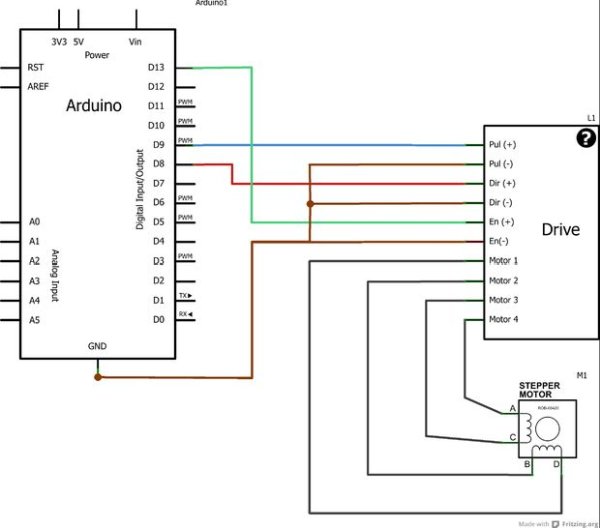
Lots of People want to build Them own small Cnc machine . they started with drives stepper motor but they stacked in controller Programming . In this instructable Robokits will provide Resource to control your Stepper motor with Arduino . before Programming we have to learn some basics Related to Stepper motor .
What is stepper motor ?
A stepper motor is a brushless, synchronous electric motor that converts digital pulses into mechanical shaft rotations. Each rotation of a stepper motor is divided into a set number of steps, sometimes as many as 200 steps. The stepper motor must be sent a separate pulse for each step. The stepper motor can only receive one pulse and take one step at a time and each step must be the same length. Since each pulse results in the motor rotating a precise angle typically 1.8 degrees you can precisely control the position of the stepper motor without any feedback mechanism.
As the digital pulses from the controller increase in frequency, the stepping movement converts into a continuous rotation with the velocity of the rotation directly proportional to the frequency of the control pulses.
Types of Stepper Motors
There are three kinds of step motors: permanent magnet, hybrid, and variable reluctance. Hyrbrid step motors offer the most versatility and combine the best characteristics of variable reluctance and permanent magnet stepper motors. Hybrid stepper motors are constructed with multi-toothed stator poles and a permanent magnet rotor. A standard hybrid stepper motor has 200 rotor teeth and rotates 1.8 degrees per step.
Half Step means that the stepping motor is rotating at 400 steps per revolution (0.9 degree steps x 400 = 360 degrees). First one winding is energized and then two windings are alternately energized. This will cause the rotor of the stepping motor to move at half the distance (0.9 degrees). In half-step mode, a typical stepper motor provides about 30% less torque, but it provides a smoother motion than it would in full-step mode.
Microstep
Microstepping energizes the stepper motor winding in a manner that further subdivides the number of positions between poles. Some microstepping controllers are capable of dividing a full step (1.8 deg) into 256 microsteps. This would result in 51,200 steps in one revolution (.007 deg/step). Microstepping is usually applied to applications that require accurate positioning and smoother motion over a broad range of speeds. As in the half-step mode, microstepping reduces torque by about 30% compared to full-step mode.
Read more: Control Nema Stepper Motor With Arduino
-
What is a stepper motor?
A brushless, synchronous electric motor that converts digital pulses into mechanical shaft rotations with precise angular control. -
How does frequency affect stepper motor speed?
As digital pulses increase in frequency, the stepping movement converts into continuous rotation with velocity proportional to pulse frequency. -
Which type of stepper motor offers the most versatility?
Hybrid step motors offer the most versatility by combining characteristics of variable reluctance and permanent magnet motors. -
What happens during half-stepping?
The motor rotates at 400 steps per revolution with smoother motion but about 30% less torque compared to full-step mode. -
How many microsteps can some controllers divide a full step into?
Some microstepping controllers can divide a full step into 256 microsteps, resulting in 51,200 steps in one revolution. -
Does microstepping reduce torque?
Yes, microstepping reduces torque by about 30% compared to full-step mode. -
When is microstepping usually applied?
It is applied to applications requiring accurate positioning and smoother motion over a broad range of speeds. -
Can you control stepper motor position without feedback?
Yes, since each pulse results in a precise angle, you can control position without any feedback mechanism.
