
Summary of Connect Tech’s V7G System Is An AI-Targeted SBC with 5th Gen Xeon-D CPU And Nvidia Pascal Cards
Connect Tech's V7G is a COM Express Type 7 system featuring 5th Gen Xeon-D processors and support for three Nvidia Pascal GPUs. It targets AI, deep learning, and visualization with up to 16 cores, 48GB ECC RAM, and multiple display or headless processing options. The platform includes dual SATA, M.2 NVMe storage, and high-speed networking via GbE and 10GbE ports.
Parts used in the V7G System:
- COM Express Type 7 module
- Xeon-D1559 processor (12-core, 1.5GHz)
- Xeon-D1577 processor (16-core, 1.3GHz)
- Nvidia Tesla P6 graphics board
- Nvidia Quadro P5000 graphics board
- Nvidia Quadro P3000 graphics board
- DDR4 ECC RAM (up to 48GB)
- Dual SATA interfaces
- Dual M.2 M-Key slots
- 10GbE network ports
- HDMI ports
Connect Tech Inc’s V7G System, which is also listed as the “COM Express Type 7 + GPU Embedded System”, is the first Xeon-D based SBC-like product. The V7G houses a 5th Gen “Broadwell” Xeon-D based COM Express Type 7 module and it can house three Nvidia Pascal-driven graphics boards. No OS support was listed yet, but it is expected to work with Linux or Windows.
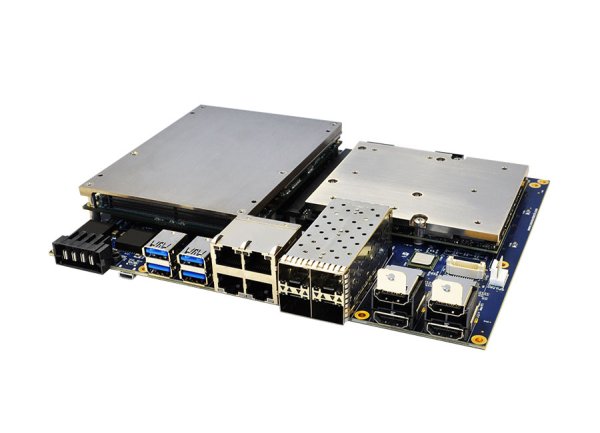
This 216 x 164mm footprint system can drive 4x independent display outputs. Alternatively, it could also be used for headless GPGPU CUDA processing for Deep Learning and Artificial Intelligence applications.
The V7G is the successor to its earlier, Xeon-E3 and Type 6-based “COM Express + GPU Embedded System”, which similarly offers the choice of Nvidia Quadro P3000 and P5000 boards. Instead of the V7G’s new Nvidia Tesla P6 option, the earlier model offers Nvidia Tesla M6 and GeForce GTX 1080 or 1050Ti graphics options. The V7G combines 10GbE and HDMI support, as well as new mini-PCIe and M.2 expansion slots.
The user can choose from a 12-core, 1.5GHz Xeon-D1559 or a 16-core, 1.3GHz Xeon-D1577, both with 45W TDP CPUs for the module. The module also comes with up to 48GB DDR4 (2400MT/s) ECC RAM. Both the 100W Quadro P5000 and more recent, 90W Tesla P6 (PDF) offer 2048 CUDA cores. The Quadro P3000, which launched last year, is limited to 1280 CUDA cores but has a lower power consumption of 75W.
The Tesla P6 is a GPU accelerator optimized for blade servers and designed originally for deep learning, visualization, and virtualization. As a drawback of this, the Tesla P6 equipped version of the V7G board lacks HDMI ports.
Storage department includes dual SATA interfaces and dual M.2 M-Key with the support of NVMe. The board implements 4x GbE and 2x 10GbE ports. The design is said to support a future upgrade path to 4x 10GbE ports.
Read more: Connect Tech’s V7G System Is An AI-Targeted SBC with 5th Gen Xeon-D CPU And Nvidia Pascal Cards
- What is the V7G System?
It is Connect Tech Inc’s first Xeon-D based SBC-like product also known as the COM Express Type 7 + GPU Embedded System. - Can the V7G drive independent displays?
Yes, the system can drive four independent display outputs. - Does the V7G support Linux or Windows?
No OS support was listed yet but it is expected to work with Linux or Windows. - Which CPU options are available for the V7G module?
Users can choose from a 12-core 1.5GHz Xeon-D1559 or a 16-core 1.3GHz Xeon-D1577. - How much RAM does the V7G support?
The module comes with up to 48GB DDR4 2400MT/s ECC RAM. - Does the Tesla P6 version have HDMI ports?
No, the Tesla P6 equipped version of the V7G board lacks HDMI ports. - What storage interfaces does the board include?
Storage includes dual SATA interfaces and dual M.2 M-Key with support of NVMe. - What networking capabilities does the V7G offer?
The board implements 4x GbE and 2x 10GbE ports with a future upgrade path to 4x 10GbE ports. - Is the V7G suitable for deep learning applications?
Yes, it can be used for headless GPGPU CUDA processing for Deep Learning and Artificial Intelligence applications. - What graphics boards did the earlier model offer compared to the V7G?
The earlier model offered Nvidia Tesla M6 and GeForce GTX 1080 or 1050Ti instead of the new Tesla P6 option.
