
Summary of COMPACT NON-INVASIVE SENSOR CHIP DEVELOPED TO RECORD MULTIPLE HEART AND LUNG SIGNALS
A Georgia Tech team developed a ladybug-sized, non-invasive accelerometer contact microphone chip that records synchronized heartbeat, respiration, lung sounds, and physical activity. The two-layer silicon sensor with a 270 nm gap detects internal vibrations—even through clothing—while an adjacent signal-conditioning circuit converts those signals into readable outputs. Tested on humans, it captured clear mechanical signals from heart and lungs. Future plans include using multiple sensors on a chest band to triangulate signal origins within the body.
Parts used in the accelerometer contact microphone project:
- Accelerometer contact microphone chip (sensor chip)
- Two thin silicon layers with a 270 nm gap
- Small voltage sources applied to each silicon layer
- Signal-conditioning circuit (electronic chip)
- Chest band for mounting multiple sensors (planned)
A team of researchers at the ‘Georgia Institute of Technology’ has come up with a non-invasive sensor-in-a-chip that records details of the heartbeat, respiration rates, and lung sounds. It even tracks the wearer’s physical activities, such as walking. The signals are recorded in sync, potentially giving healthcare workers a detailed overview of a patient’s heart and lungs.
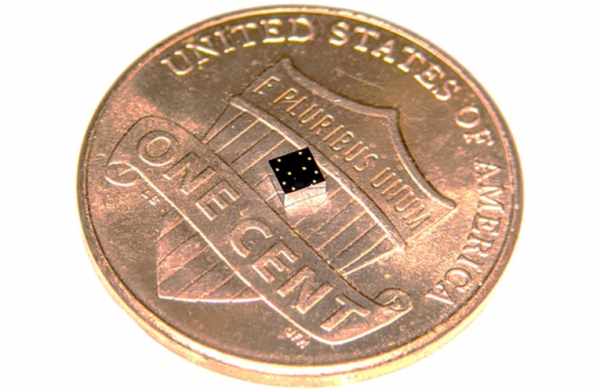
The ladybug sized chip acts as a high-tech electronic stethoscope combined with an accelerometer and is called an accelerometer contact microphone. It detects vibrations that enter from inside the body while filtering out distracting noises from outside the body’s core like airborne sounds. The sounds thus produced are analyzed to get detailed information on the patient.
The device is sensitive to sounds coming at it from inside the body and it picks up useful vibrations even through clothing. The chip has two thin layers of silicon sandwiching a 270 nm gap, each carrying a small voltage which gives it a sensing capability. Vibrations from bodily motions and sounds send pressure waves through the chip which makes the voltage change subtly and creates readable electronic outputs.
The sensor is a chip attuned to vibrations and next to it is an electronic chip called a signal-conditioning circuit that translates the sensor chip’s signals into patterned read-outs. While the chip was being tested on humans, it recorded a variety of signals from the mechanical workings of the lungs and the heart with great clarity. The team plans to attach three sensors or more to a chest band to triangulate signals, determining exactly where they come from inside the body.
Read more: COMPACT NON-INVASIVE SENSOR CHIP DEVELOPED TO RECORD MULTIPLE HEART AND LUNG SIGNALS
- What does the sensor chip record?
It records heartbeat details, respiration rates, lung sounds, and wearer physical activities such as walking. - How does the chip detect internal body sounds?
Two thin silicon layers with a 270 nm gap carry small voltages; vibrations send pressure waves that change the voltage, producing readable electronic outputs. - Can the device pick up sounds through clothing?
Yes, the device is sensitive to sounds coming from inside the body and picks up useful vibrations even through clothing. - What additional electronics are used with the sensor chip?
An adjacent signal-conditioning circuit translates the sensor chip's signals into patterned read-outs. - Does the device filter out external noises?
Yes, it detects vibrations from inside the body while filtering out distracting airborne sounds from outside the body's core. - Was the chip tested on humans?
Yes, during testing on humans it recorded a variety of mechanical signals from the lungs and heart with great clarity. - How many sensors do the researchers plan to use for better localization?
The team plans to attach three sensors or more to a chest band to triangulate signals and determine exact origins inside the body. - What is the size comparison given for the chip?
The chip is described as ladybug sized.
