
Summary of Bluetooth 5.3 SoC: The Future of Wireless Connectivity
The BlueNRG-LPS is an ultra-low power Bluetooth Low Energy 5.3 SoC by STMicroelectronics featuring an Arm Cortex-M0+ core and dedicated BLE coprocessor. It supports Mesh networking, proprietary 2.4 GHz links, and advanced security features like AES-128 and PKA. With 192 KB flash and multiple communication interfaces, it operates in extreme temperatures with high efficiency.
Parts used in the BlueNRG-LPS Project:
- Arm Cortex-M0+ microcontroller
- Dedicated Bluetooth Low Energy core coprocessor
- Hardware true random number generator
- AES encryption module (up to 128-bit)
- Public key accelerator (PKA)
- 192 KB flash memory
- 24 KB RAM
- 12-bit ADC
- Low-power RTC
- SPI/I2S, UART, and I2C interfaces
Description
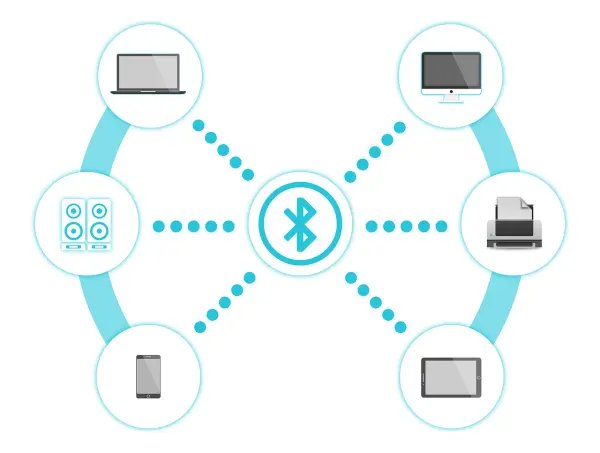
The BlueNRG-LPS is an ultra-low power programmable Bluetooth Low Energy wireless system-on-chip (SoC) solution from STMicroelectronics. It includes highly optimized 2.4 GHz radio IPs for excellent radio performance and minimal power consumption, allowing for exceptional battery life. The BlueNRG-LPS supports Bluetooth Low Energy 5.3, enabling point-to-point connections and Bluetooth Mesh networking to reliably establish large device networks. It can also be used for proprietary 2.4 GHz wireless communication requiring ultra-low latency.
The BlueNRG-LPS contains an Arm Cortex-M0+ microcontroller that operates up to 64 MHz and a dedicated Bluetooth Low Energy core coprocessor for handling timing-critical operations via DMA. It supports key Bluetooth Low Energy 5.3 features such as 2 Mbps data rate, long-range coded PHY, advertising extensions, channel selection algorithm #2, GATT caching, direction finding, simultaneous connections in multiple roles, extended packet length, LE Ping procedure, periodic advertising, and more.
The BlueNRG-LPS offers enhanced security with hardware true random number generation, AES encryption up to 128-bit, public key accelerator (PKA), CRC calculation, unique 64-bit ID, and flash memory protection. The PKA supports modular arithmetic and scalar multiplication for elliptic curves up to specified sizes.
The BlueNRG-LPS can function as a standalone device managing the application and Bluetooth stack, or as a network processor. It contains high-speed memory types such as 192 KB flash, 24 KB RAM, 1 KB OTP ROM, and 7 KB system ROM. Direct data transfer between memory and peripherals is enabled via eight DMA channels. Additional features include a 12-bit ADC, low-power RTC, timers, SPI/I2S, UART, I2C, and standard communication interfaces.
The BlueNRG-LPS operates from -40 to +105°C on a 1.7V to 3.6V supply. Comprehensive power saving modes allow low-power design. An integrated switching regulator and power dropout circuit generate resets when VDD drops below 1.65V. Package options provide up to 20 I/Os.
- What Bluetooth version does the BlueNRG-LPS support?
The device supports Bluetooth Low Energy 5.3. - Can the BlueNRG-LPS be used for Mesh networking?
Yes, it enables Bluetooth Mesh networking to reliably establish large device networks. - How fast can the microcontroller operate?
The Arm Cortex-M0+ microcontroller operates up to 64 MHz. - Does the chip include hardware-based security features?
Yes, it includes hardware true random number generation, AES encryption up to 128-bit, and a public key accelerator. - What is the maximum data rate supported?
The chip supports a 2 Mbps data rate as part of Bluetooth Low Energy 5.3 features. - How much flash memory is available on the device?
The BlueNRG-LPS contains 192 KB of flash memory. - What is the operating temperature range?
The device operates from -40 to +105°C. - Can the chip function without an external processor?
Yes, it can function as a standalone device managing the application and Bluetooth stack.
