
Summary of BLE MODULES INCLUDE ANTENNA, ENCRYPTION TECHNOLOGY, SIX CONFIGURABLE I/O PINS
Würth Elektronik introduced two compact 8 × 12 × 2 mm wireless modules: Proteus-III (BLE 5.1) and proprietary Thyone-I. Both include integrated antennas, encryption, six configurable I/O pins, and use WE-ProWare firmware on the Nordic nRF52840 chipset (Proteus-III) or a 2.4 GHz platform (Thyone-I). Proteus-III supports BLE 5.1 features, 964-byte payloads, long range mode, NFC wake-up/pairing readiness, and SPP-like serial transmission. Thyone-I offers up to 750 m range, 400 kbps throughput, mesh repeater capability, and can be adapted to ZigBee, Thread, or Wirepas if needed.
Parts used in the Proteus-III and Thyone-I modules:
- Würth Elektronik Proteus-III module (BLE 5.1, 8 × 12 × 2 mm)
- Würth Elektronik Thyone-I proprietary 2.4 GHz module (8 × 12 × 2 mm)
- Integrated antenna (on-module)
- Encryption technology (on-module)
- Six configurable I/O pins (on-module)
- Nordic Semiconductor nRF52840 chipset (used in Proteus-III)
- WE-ProWare firmware from Würth Elektronik
- NFC hardware support (for NFC wake-up and NFC pairing readiness)
Würth Elektronik announced the Bluetooth Low Energy 5.1 module Proteus-III and the proprietary version Thyone-I. The modules, measuring only 8 × 12 × 2 mm, with integrated antenna, encryption technology and six configurable IO pins, are based on the Nordic Semiconductor nRF52840 chipset. They can be used for IoT and M2M applications, for example, to build radio-based maintenance interfaces and sensor networks. The WE-ProWare firmware from Würth Elektronik, which has been industrially proven over many years, makes the modules extremely versatile.
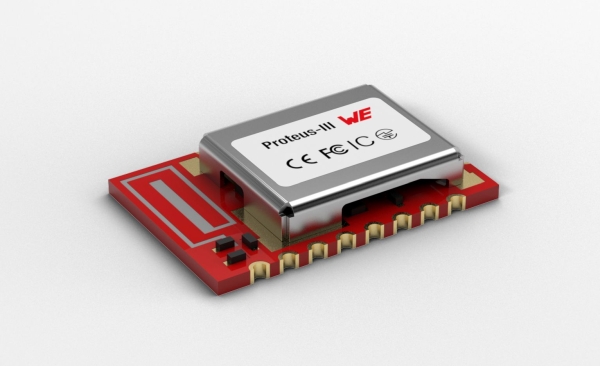
Proteus-III exploits the possibilities of the Bluetooth Low Energy 5.1 standard and even goes beyond them. With a payload of up to 964 bytes, the module offers four times the throughput of previous Bluetooth Low Energy modules. It can also establish connections in the newly introduced long range mode to transmit data over long distances. A special feature from Würth Elektronik: Proteus-III offers a good alternative to the SPP (Serial Port Profile) mode for serial data transmission, which is no longer included in the standard but is extremely useful for industrial applications. NFC wake-up and NFC pairing are prepared.
With the proprietary Thyone-I radio module, Würth Elektronik shows what is possible in the 2.4 GHz band: a range of up to 750 m and an end-to-end payload throughput of up to 400 kbps. A simple setup turns modules into repeaters in a mesh network, as required. WE-ProWare is an extremely versatile, easy-to-configure firmware with a lean and powerful radio protocol. If transmission standards are already specified in the application, Thyone-I can easily be converted to ZigBEE, Thread or Wirepas.
Read more: BLE MODULES INCLUDE ANTENNA, ENCRYPTION TECHNOLOGY, SIX CONFIGURABLE I/O PINS
- What chip does Proteus-III use?
Proteus-III is based on the Nordic Semiconductor nRF52840 chipset. - Do the modules include an integrated antenna?
Yes, both Proteus-III and Thyone-I include an integrated antenna. - How many configurable I/O pins do the modules provide?
Both modules provide six configurable I/O pins. - What payload size does Proteus-III support?
Proteus-III supports a payload of up to 964 bytes. - Can Proteus-III support long range connections?
Yes, Proteus-III can establish connections in long range mode. - Is NFC supported for Proteus-III?
NFC wake-up and NFC pairing are prepared for Proteus-III. - What range and throughput does Thyone-I achieve?
Thyone-I can achieve a range of up to 750 m and an end-to-end payload throughput of up to 400 kbps. - Can Thyone-I operate as a mesh repeater?
Yes, a simple setup can turn Thyone-I modules into repeaters in a mesh network. - Can Thyone-I be converted to other protocols?
Yes, Thyone-I can be converted to ZigBee, Thread, or Wirepas if transmission standards are already specified in the application. - What firmware is used on these modules?
Both modules use WE-ProWare firmware from Würth Elektronik.
