
Summary of BADMINTON STRING WINDER GETS THE TENSION JUST RIGHT
Summary: After an injury sidelined him, Antonie Colin built a badminton racket restringing machine using common motion components and 3D-printed parts. The machine uses a stepper-driven leadscrew and load cell to apply and monitor string tension (18–34 lbs), controlled by an Arduino and displayed on an LCD. Flying clamps hold strings during the process, and the device supports prestretching. The build offers a reliable alternative to pro shop restringing for regular players.
Parts used in the Badminton Racket Restringing Machine:
- Racket holding round assembly (3D-printed parts)
- Leadscrew mechanism
- Stepper motor
- Load cell
- Arduino
- LCD screen
- Flying clamps (upper and lower mounting options)
- Common motion components (bearings, shafts, fasteners)
- 3D-printed structural parts and mounts
If you want to keep your badminton game at its peak, you’ll need a good racket with a proper set of strings. When an injury kept [Antonie Colin] off the court for a few months, building a restringing machine helped pass the time.
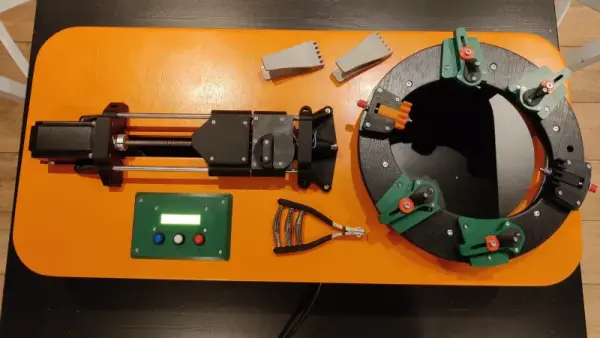
The design is straightforward, using commonly-available motion components and 3D-printed parts. The round assembly at one end is used to hold the racket during the restringing process. A leadscrew mechanism driven by a stepper motor is used to apply tension to the strings, anywhere from 18 lbs to 34 lbs. Strings can also be prestretched if so desired. The stringing process is managed by an Arduino, which uses a loadcell to monitor tension placed on the strings. An LCD screen on the device provides feedback on the process and allows various functions to be selected. Flying clamps are used to hold strings in place during the process, either fitted from above or below the device as needed.
If you find yourself regularly restringing your badminton racket, or you simply don’t trust your local pro shop to do so, you might find this build useful. You might also like to build a shuttlecock launcher for training if your practice partners aren’t available on the regular. Our badminton department is looking rather bare at the moment, so don’t hesitate to send your own nifty hacks in to the tipsline!
Source: BADMINTON STRING WINDER GETS THE TENSION JUST RIGHT
- What drove the maker to build the restringing machine?
An injury kept Antonie Colin off the court for a few months, so building the machine helped pass the time. - What mechanism applies tension to the strings?
A leadscrew mechanism driven by a stepper motor applies tension to the strings. - How is string tension monitored?
A load cell is used by the Arduino to monitor the tension placed on the strings. - What tension range can the machine apply?
The machine can apply tension anywhere from 18 lbs to 34 lbs. - Can the machine prestretch strings?
Yes, strings can be prestretched if desired. - How does the user interact with the machine?
An LCD screen provides feedback and allows various functions to be selected. - How are strings held in place during stringing?
Flying clamps are used to hold strings in place, fitted from above or below as needed. - Are parts of the machine 3D-printed?
Yes, the design uses 3D-printed parts along with commonly-available motion components. - Who might find this build useful?
People who regularly restring their badminton racket or who do not trust their local pro shop may find this build useful.
