
Summary of ARDUINO REDUCES HEATING COSTS
Karl built an Arduino-based zone heating controller that uses radiator valves and temperature sensors at each valve, connected to an Arduino Mega, to apply heat only where and when needed. The system schedules temperatures by time of day, controls the circulating pump and boiler equipment, and improves efficiency compared to whole-home heating. The approach could be adapted to furnace/air-handler systems with more complex vent control.
Parts used in the Arduino-based zone heating controller:
- Arduino Mega
- Radiator valves with actuators
- Temperature sensors (one at each valve)
- Alarm wiring for connections between valves/sensors and Arduino
- Circulating pump (controlled by the system)
- Boiler control interface components
While almost everyone has a heater of some sort in their home, it’s fairly unlikely that the heat provided by a central heating system such as a furnace is distributed in an efficient way. There’s little reason to heat bedrooms during the day, or a kitchen during the night, but heating systems tend to heat whole living space regardless of the time of day or the amount of use. You can solve this problem, like most problems, with an Arduino.
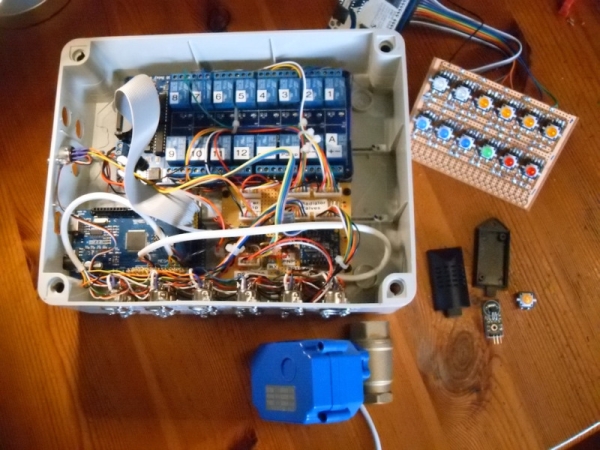
[Karl]’s build uses a series of radiator valves to control when each room gets heat from a boiler. The valves, with a temperature monitor at each valve, are tied into a central Arduino Mega using alarm wiring. By knowing the time of day and the desired temperature in each room, the Arduino can control when heat is applied to each room and when it is shut off, presumably making the entire system much more efficient. It also has control over the circulating pump and some of the other boiler equipment.
Presumably this type of system could be adapted to a system which uses a furnace and an air handler as well, although it is not quite as straightforward to close vents off using a central unit like this as it is to work with a boiler like [Karl] has. With careful design, though, it could be done. Besides replacing thermostats, we can’t say we’ve ever seen this done before.
Source: ARDUINO REDUCES HEATING COSTS
- What does the Arduino control in this heating system?
The Arduino Mega controls radiator valves, reads temperature sensors, and manages the circulating pump and some boiler equipment. - How does the system decide when to heat each room?
The Arduino uses time of day and desired temperature settings for each room to decide when to apply or shut off heat. - What wiring is used to connect valves and sensors to the Arduino?
Alarm wiring is used to tie the valves and temperature monitors into the central Arduino Mega. - Can this approach be adapted to a furnace and air handler?
Yes, it could be adapted, but closing vents with a central unit is less straightforward and requires careful design. - Does the system replace individual thermostats?
Yes, the system replaces thermostats by controlling temperature and heating for each room centrally. - What is the expected benefit of this setup?
The expected benefit is increased heating efficiency by heating only occupied rooms at desired times.
