
Summary of Arduino Portenta H7 Lite industrial development board
The Arduino Portenta H7 Lite is a new industrial-grade development board featuring a dual-core STM32H747 processor (Cortex M7 and M4). It supports various software environments including Arm Mbed OS, MicroPython, JavaScript, and TensorFlow Lite. Designed for Industry 4.0 IoT projects, it offers WiFi and Bluetooth connectivity with an 80-pin high-density connector, making it ideal for AI applications and low-latency control in machinery or laboratory equipment.
Parts used in the Arduino Portenta H7 Lite:
- Dual-core STM32H747 processor
- Cortex M7 core running at 480 MHz
- Cortex M4 core running at 240 MHz
- Remote Procedure Call mechanism
- Arduino MKR form factor
- 80-pin high-density connector
- Onboard wireless module
- WiFi interface
- Bluetooth® interface
The team responsible for officially pushing forward the Arduino ecosystem has this week introduced a new industrial grade development board in the form of the Arduino Portenta H7 Lite. Powered by a dual-core STM32H747 including a Cortex M7 running at 480 MHz and a Cortex M4 running at 240 MHz.
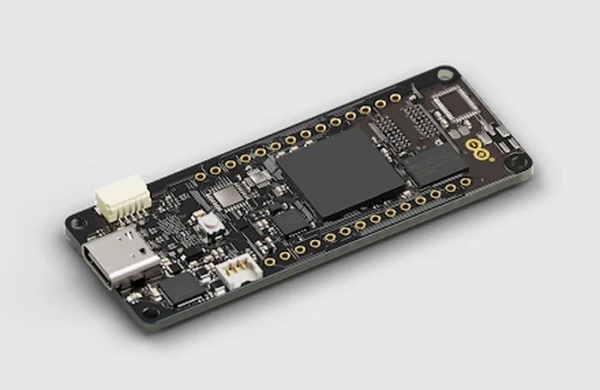
The two cores communicate via a Remote Procedure Call mechanism that allows calling functions on the other processor seamlessly. Both processors share all the in-chip peripherals and can run: Arduino sketches on top of the Arm Mbed OS, Native Mbed applications, MicroPython / JavaScript via an interpreter and TensorFlow Lite if desired.
“We’re proud to announce the latest addition to our industrial range, the new Portenta H7 Lite. Designed for developers who want the computational power of Arduino Pro’s Portenta H7 flagship, but don’t need the video output, additional security features or connectivity. For your next Industry 4.0 IoT project, all you have to do is choose which Portenta board suits your needs best. You’ve got a great new choice, and we have you covered!”
Arduino Portenta H7 Lite development board specifications
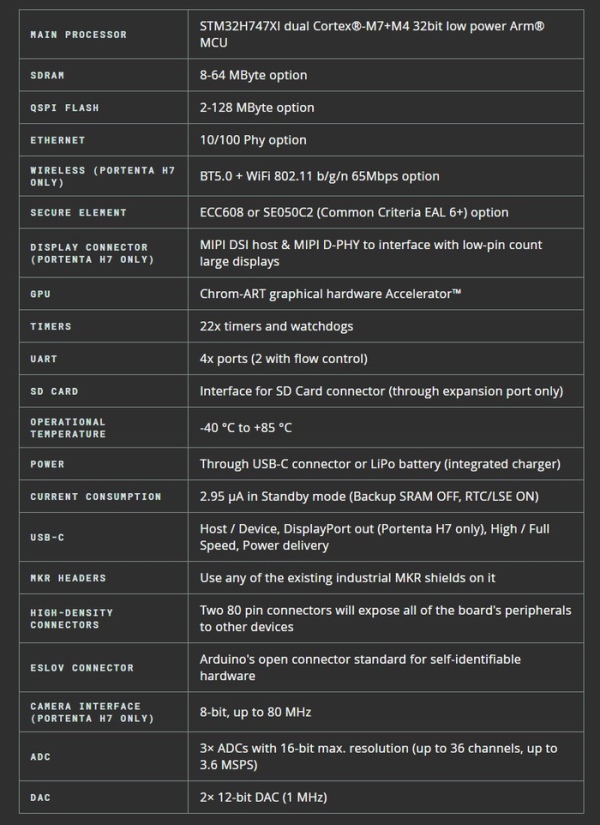
The new Arduino Portenta H7 Lite development board is available to purchase priced at $72 and complies with the Arduino MKR form factor, but is enhanced with the Portenta family’s 80-pin, high-density connector.
The Portenta H7 Lite is a streamlined, tightly targeted solution for AI applications and low-latency control projects. Perfect for everything from high-end industrial machinery to laboratory equipment and mission-critical devices. The onboard wireless module allows to simultaneously manage WiFi and Bluetooth® connectivity on the Portenta H7. The WiFi interface can be operated as an Access Point, as a Station or as a dual mode simultaneous AP/STA and can handle up to 65 Mbps transfer rate. Bluetooth® interface supports Bluetooth Classic and BLE.”
Source: Arduino Portenta H7 Lite industrial development board
- What processors power the Arduino Portenta H7 Lite?
It is powered by a dual-core STM32H747 including a Cortex M7 running at 480 MHz and a Cortex M4 running at 240 MHz. - How do the two cores communicate on this board?
The two cores communicate via a Remote Procedure Call mechanism that allows calling functions on the other processor seamlessly. - Can I run TensorFlow Lite on the Portenta H7 Lite?
Yes, both processors can run TensorFlow Lite if desired alongside other options like MicroPython or JavaScript. - What is the price of the Arduino Portenta H7 Lite?
The new Arduino Portenta H7 Lite development board is available to purchase priced at $72. - Does the Portenta H7 Lite support simultaneous WiFi and Bluetooth?
Yes, the onboard wireless module allows you to simultaneously manage WiFi and Bluetooth connectivity. - What are the transfer rates supported by the WiFi interface?
The WiFi interface can handle up to 65 Mbps transfer rate. - Is the Portenta H7 Lite compatible with the Arduino MKR form factor?
Yes, the board complies with the Arduino MKR form factor but includes the Portenta family's 80-pin high-density connector. - What types of projects is this board best suited for?
It is perfect for everything from high-end industrial machinery to laboratory equipment and mission-critical devices.
