
Summary of ARDUINO PLOTS YOUR PORTRAIT WITH STYLE
The Portable Portrait Painter is a standalone CNC plotter built by [Ben Lucy] that captures its own photos and draws portraits without external input. Using an OV7670 camera and Arduino Mega2560, it displays a live preview on an LCD screen. The device processes images with histogram compensation to adjust contrast, then plots lines where stroke thickness varies based on pixel darkness. This analog approach creates detailed, stylized portraits with unique edge artifacts, making it an impressive conversation piece for maker events.
Parts used in the Portable Portrait Painter:
- OV7670 camera
- Arduino Mega2560
- Color LCD screen
- Pen plotter mechanism
- Button for capture control
Around these parts, we see plenty of plotter builds. They’re a great way to learn about CNC machines and you get to have fun making pictures along the way. [Ben Lucy] was undertaking just such a build of his own, but wanted to do something standalone that served a purpose. The result is the impressive Portable Portrait Painter.
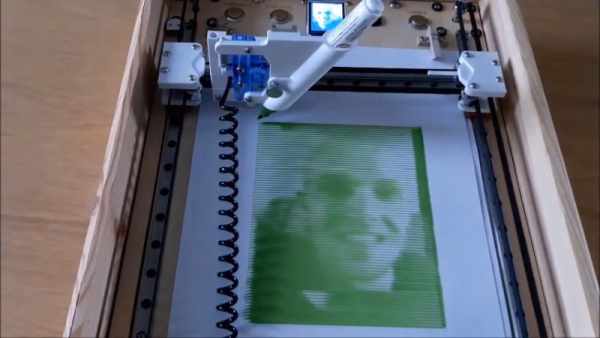
What sets [Ben]’s project apart is how complete it is. Unlike other plotters that simply follow G-code instructions or process external images, the Portable Portrait Painter is a completely standalone machine. Fitted out with an OV7670 camera, hooked up to an Arduino, it’s capable of taking its own photos and then drawing them out as well.
Through some clever code from [Indrek Luuk], the Arduino Mega2560 is able to display a 20fps video preview on a color LCD screen. When the user presses a button, the current frame is captured and sent to the pen plotter. The plotting algorithm is particularly impressive, with images first processed with histogram compensation to maximise contrast. The pen is then drawn across the page line by line, and pressed into the page by varying amounts depending on the color value of each pixel. The darker the pixel, the thicker the stroke made by the pen. This more analog approach produces a much more detailed image than more basic plotters which either leave a mark or don’t.
The portraits produced by the plotter are impressive, and we like the edge-of-page artifacts, which add a little style to the final results. The Portrait Painter would make a great conversation piece at any Maker Faire or hackerspace night.
It’s a project that reminds us of some of the painting robots we’ve seen over the years. Video after the break.
Source: ARDUINO PLOTS YOUR PORTRAIT WITH STYLE
- What makes this project different from other plotters?
The machine is completely standalone, capable of taking its own photos and drawing them without external G-code or image files. - How does the user capture an image?
A button press triggers the system to capture the current frame from the video preview and send it to the plotter. - What hardware allows the live video preview?
Clever code from Indrek Luuk enables the Arduino Mega2560 to display a 20fps video preview on a color LCD screen. - How does the plotting algorithm handle image contrast?
Images are processed with histogram compensation to maximize contrast before plotting begins. - How is the pen pressure controlled during drawing?
The pen is pressed into the page by varying amounts depending on the color value of each pixel. - What determines the thickness of the pen strokes?
The darker the pixel, the thicker the stroke made by the pen. - Why is this approach considered more analog than basic plotters?
Basic plotters either leave a mark or do not, whereas this method varies stroke thickness for much more detail. - What visual characteristic adds style to the final results?
The portraits feature edge-of-page artifacts that add a little style to the final results.
