
Summary of AN EXOSKELETON ARM FOR A HACKER ON A BUDGET
Kristjan Berce demonstrates a low-cost, functional powered exoskeleton arm designed to assist with lifting tasks. Built using hand tools on aluminum and wood, the device utilizes an automotive wiper motor for power and a LiPo battery for energy. Controlled via an Arduino and glove-mounted buttons with elbow joint feedback, it successfully lifts heavy objects like a bicycle. The project highlights both the potential of DIY engineering and the importance of user-led design in medical assistive technology.
Parts used in the Exoskeleton Arm:
- Automotive windscreen wiper motor
- LiPo battery
- Feedback potentiometer
- Arduino microcontroller
- Glove-mounted buttons
- Aluminum pieces
- Wood pieces
- Hand tools
- Drill press
Whether it is motivated by a dream of superhuman strength courtesy of a mech suit or of mobility for those with impaired muscle function, the powered exoskeleton exerts a curious fascination among engineers. The idea of a machine-augmented human body achieving great things is thwarted though by the difficulty of the task, actuators and power sources small enough to be worn comfortably represent a significant challenge that is not easily overcome. It’s a subject that has captivated [Kristjan Berce] since at a young age seeing his grandmother struggling with lifting, and he presents a working powered exoskeleton arm as a proof of his ideas.
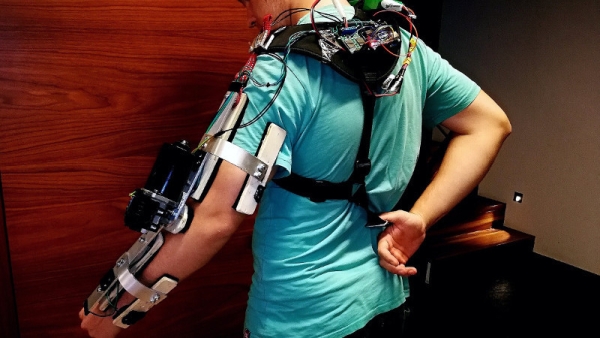
It’s a wonderful exercise in low-tech construction with hand tools and a drill press on pieces of aluminium and wood. Motive power comes from an automotive windscreen wiper motor, and electrical power comes from a hefty LiPo attached to the device’s harness. There is a feedback potentiometer incorporated into the elbow joint, and an Arduino oversees the operation under the direction of a pair of glove-mounted buttons. It’s certainly impressive to see it in the video below lifting a bicycle, though we wonder how its weight might affect someone with less muscle function than average.
Projects like this one are very good to see, because there’s a chance that somebody out there may be helped by building one of these. However there is always a note of caution to be struck, as the best solutions come from those who need them and not those who merely think they have the solution. We have written about the Engineer Saviour Trap here in years past.
This isn’t the first prosthetic arm we’ve seen though, we covered a hackerspace in England printing one for a local youngster.
Source: AN EXOSKELETON ARM FOR A HACKER ON A BUDGET
- What motivated Kristjan Berce to build this exoskeleton?
He was inspired by watching his grandmother struggle with lifting when he was young. - How is motive power provided in the device?
Motive power comes from an automotive windscreen wiper motor. - What provides the electrical power for the system?
A hefty LiPo battery attached to the device's harness supplies the electricity. - How does the user control the operation of the arm?
An Arduino oversees operation under the direction of a pair of glove-mounted buttons. - Where is the feedback mechanism located?
A feedback potentiometer is incorporated into the elbow joint. - Can this specific exoskeleton lift heavy objects?
Yes, the video shows it successfully lifting a bicycle. - What materials were primarily used to construct the frame?
The construction uses pieces of aluminium and wood. - Does the article suggest this is the best solution for everyone?
No, the text warns that the best solutions come from those who need them rather than those who think they have the answer.
