
Summary of AMBIENT HUMIDITY ENERGY HARVESTERS COULD COMPETE WITH SOLAR CELLS
Researchers at the University of Massachusetts developed a durable energy harvester using protein nanowires from *Geobacter sulfurreducens*. This 7µm-thick thin-film device generates electricity by leveraging water molecule adsorption-desorption cycles in ambient air. Operating over two months, it produced ~0.5V and 17µA/cm² current density, achieving a power density of 4mW/cm³—significantly higher than previous moisture-based technologies. The mechanism involves ionization gradients within the nanowire mesh exposed to humidity levels ranging from 20% to 100%.
Parts used in the Ambient Humidity Energy Harvester:
- Nanoporous mesh of protein nanowires
- Protein nanowires sheared from Geobacter sulfurreducens
- Large gold electrode
- Glass substrate
- Thin top electrode
Leveraging the natural adsorption–desorption exchange of water molecules from ambient air at the interface of a nanoporous mesh of protein nanowires, a team of researchers from the University of Massachusetts has demonstrated a durable form of energy harvesting that could potentially compete with solar cells on volumetric power density. By Julien Happich @ eenewseurope.com
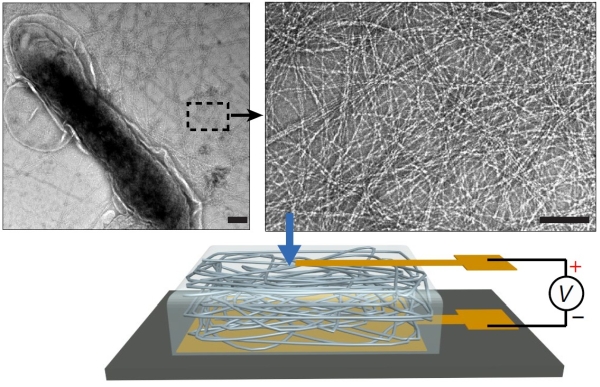
Publishing their results in the Nature journal under the title “Power generation from ambient humidity using protein nanowires”, the researchers describe a thin-film device (only 7µm-thick) consisting of a mesh of electrically conductive protein nanowires (sheared from the microorganism Geobacter sulfurreducens) laid on top of a large gold electrode over a glass substrate for the bottom side, and covered with a thin top electrode leaving the mesh exposed to ambient air.
In this configuration, the device, only a few millimetres square, was able to produce a sustained voltage of around 0.5 volts across the two electrodes, delivering a current density of around 17µA/cm2, for over 20h before self-recharging. The authors estimated the device’s power density to roughly 4mW/cm3, two orders of magnitude higher than previous reported energy-harvesting technologies relying on ambient, atmospheric moisture.
They tested their device for more than two months, it maintained a stable direct-current voltage of between 0.4 and 0.6V with fluctuations in voltage only associated with changes in ambient relative humidity (with 40–50% relative humidity yielding the highest voltage. The device was proven to still output power at a relative humidity as low as 20% (comparable to a desert environment) as well as at 100% humidity.
When the film is exposed to ambient humidity, a self-maintained moisture gradient (a depth-dependent difference in moisture adsorption) forms within the film, the researchers observed, which itself creates an ionization gradient in the carboxylic groups or a concentration gradient in mobile protons of the nanowires’ surface functional groups. The resulting charge diffusion induces a counterbalancing electrical field or a potential analogous to the resting membrane potential in biological systems, the authors explain, noting that a wide range of synthetic protein nanowires would likely be suitable for the design of similar ambient air energy-harvesting devices.
Read more: AMBIENT HUMIDITY ENERGY HARVESTERS COULD COMPETE WITH SOLAR CELLS
- What is the thickness of the device described?
The device is a thin-film structure that is only 7 micrometers thick. - How long did the device maintain stable voltage output?
The device maintained stable direct-current voltage for more than two months. - Can the device operate in low humidity environments?
Yes, the device was proven to still output power at a relative humidity as low as 20 percent. - What is the estimated power density of this technology?
The authors estimated the device's power density to be roughly 4 milliwatts per cubic centimeter. - Which microorganism provides the protein nanowires?
The electrically conductive protein nanowires are sheared from the microorganism Geobacter sulfurreducens. - Does the voltage fluctuate with changes in humidity?
Fluctuations in voltage are associated with changes in ambient relative humidity. - What creates the electrical field in the device?
A self-maintained moisture gradient forms within the film, creating an ionization gradient or concentration gradient in mobile protons. - Is this technology comparable to solar cells?
The device could potentially compete with solar cells on volumetric power density.
