
Summary of ADVANTECH RELEASES NXP I.MX8 QUADMAX ROM-7720, QSEVEN MODULE FOR AI AND MACHINE VISION APPLICATION
Advantech announces the ROM-7720, its first NXP i.MX8 Qseven module powered by the i.MX8 Quad Max (two Cortex-A72, four Cortex-A53, two Cortex-M4F) with Vivante GC7000XS/VX GPU. It supports 4K HDMI 2.0 (H.265/H.264 hardware decode), dual LVDS, multiple MIPI-CSI cameras, and OpenVX/OpenCL/OpenGL ES for AI, machine vision, and analytics. High-speed I/O includes USB 3.0, PCIe 3.0, and SATA 3.0. Advantech also provides AIM-Linux embedded software services for accelerated development and long-term support.
Parts used in the ROM-7720 QSEVEN module:
- NXP i.MX8 Quad Max SoC (2x Cortex-A72, 4x Cortex-A53, 2x Cortex-M4F)
- Vivante GC7000XS/VX graphics engine
- HDMI 2.0 interface (supports 3840 x 2160 @60Hz)
- H.265 and H.264 hardware accelerator engines
- Dual 24-bit LVDS display outputs
- 2 + 4 lane MIPI-CSI camera inputs
- USB 3.0 interface
- PCIe 3.0 interface
- SATA 3.0 interface
- Qseven module form factor and connectors
- AIM-Linux embedded software services (AIM framework)
Advantech, a global leader in the embedded computing market, is pleased to announce its first NXP i.MX8 product: ROM-7720, an Arm-based Qseven module powered by the NXP Arm® CortexTM-A72 i.MX8 high-performance processor. ROM-7720 supports 4K resolution via HDMI 2.0 with H.265 H264 hardware accelerator engines for video decoding and additional GPU for image processing. Using OpenVX, it is ideal for AI, machine vision, and big data processing and analytics applications in the IoT era.
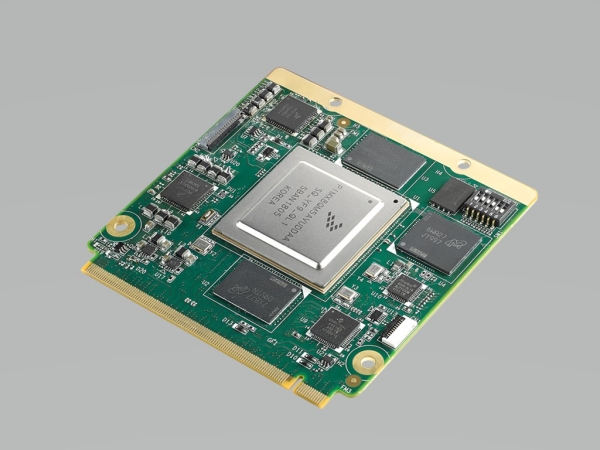
Powerful Computing Performance for Visual Processing
ROM-7720 adopts NXP i.MX8 Quad Max SoC, which integrates two CortexTM-A72, four Cortex-A53 and two Cortex-M4F processor cores and the Vivante GC7000XS/VX graphics engine, which supports OpenGL ES, OpenCL and OpenVL (vision) SDK for developing images, data processing, and analytics applications. ROM-7720 supports display output with HDMI2.0 (3840 x 2160 @60Hz), dual 24bit LVDS for multiple displays, and 2 + 4 lanes MIPI-CSI camera input. It supports a high resolution display and meets the camera requirements of different machine vision applications.
New High Speed Interface for AI and Machine Vision Applications
ROM-7720 offers new high speed I/O, including USB 3.0, PCIe 3.0 and SATA 3.0. It provides efficient interfaces for extending peripheral devices, such as the SSD, 5G cellular card, and FPGA IC to empower new AI and machine vision development.
Value-Added Embedded Software Services: AIM-Android Services
Advantech will support allied, industrial and modular (AIM) frameworks for Linux applications that help accelerate software development via flexible, long-term support. AIM-Linux services offer verified embedded OS platforms and industrial-focused apps and SDKs through which users can easily select the embedded software tools they need to focus on their vertical software development.
Read more: ADVANTECH RELEASES NXP I.MX8 QUADMAX ROM-7720, QSEVEN MODULE FOR AI AND MACHINE VISION APPLICATION
- What processor does the ROM-7720 use?
The ROM-7720 uses the NXP i.MX8 Quad Max SoC with two Cortex-A72, four Cortex-A53 and two Cortex-M4F cores. - Does the ROM-7720 support 4K display output?
Yes, it supports HDMI 2.0 at 3840 x 2160 @60Hz. - Can the ROM-7720 handle hardware video decoding?
Yes, it includes H.265 and H.264 hardware accelerator engines for video decoding. - What graphics and vision SDKs are supported?
It supports the Vivante GC7000XS/VX graphics engine with OpenGL ES, OpenCL and OpenVX (vision) SDK support. - What camera interfaces does the module provide?
It provides 2 + 4 lane MIPI-CSI camera inputs. - What high-speed I/O options are available?
The ROM-7720 offers USB 3.0, PCIe 3.0 and SATA 3.0 interfaces. - Is ROM-7720 suitable for AI and machine vision applications?
Yes, its CPU/GPU architecture, OpenVX support, and camera/display interfaces make it ideal for AI and machine vision. - Does Advantech provide software support for the module?
Yes, Advantech provides AIM-Linux embedded software services and AIM frameworks for development and long-term support.
