
Summary of A DIGITAL MAGIC 8-BALL? SIGNS POINT TO YES
This project by FacelessTech is a digital Magic 8-Ball that functions as both an answer generator and a 6-sided die. Built on a whim, it utilizes a Nokia 5110 screen and a 3-axis gyro controlled by an Arduino Pro Mini to interpret motion for answers and contrast adjustment. The open-source build features a custom PCB and includes a GX-12 connector for convenient FTDI programming.
Parts used in the Digital Magic 8-Ball:
- Nokia 5110 screen
- Arduino Pro Mini
- 3-axis gyro
- GX-12 connector
- FTDI programmer interface
- Custom PCB
[FacelessTech] was recently charmed by one of our prized possessions as a kid — the Magic 8-Ball — and decided to have a go at making a digital version. Though there is no icosahedron or mysterious fluid inside, the end result is still without a doubt quite cool, especially for a project made on a whim with parts on hand.
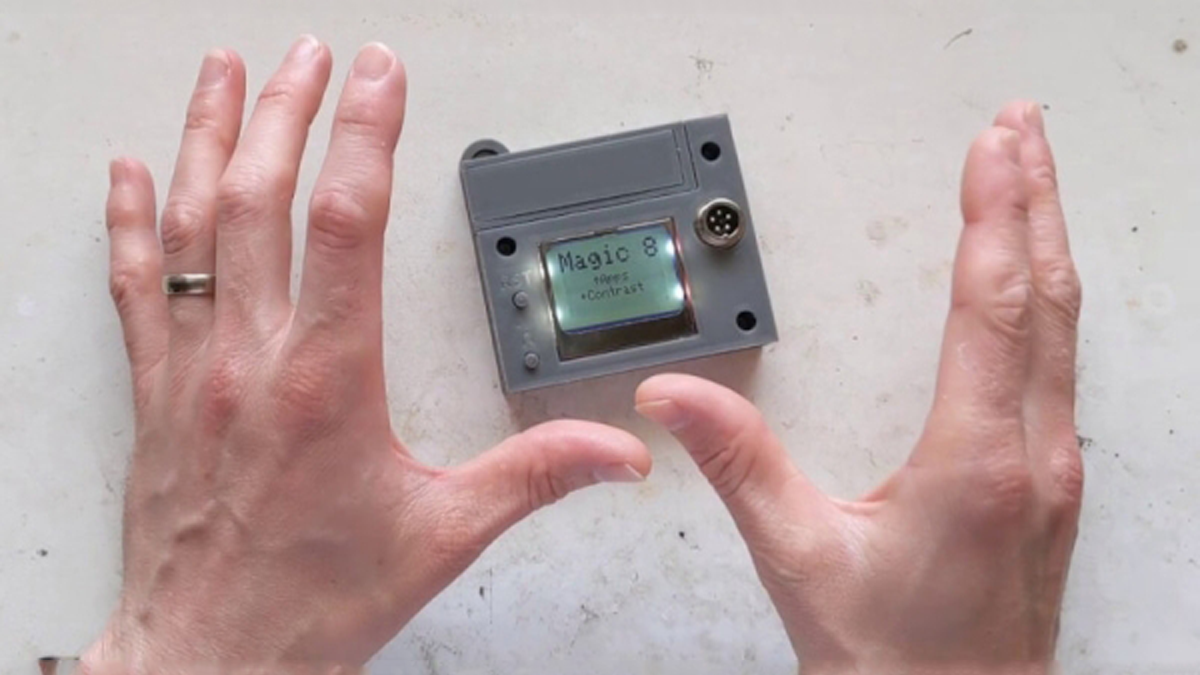
It’s not just an 8-ball, it also functions as a 6-sided die and a direct decider of yes/no questions. Underneath that Nokia 5110 screen there’s an Arduino Pro Mini and a 3-axis gyro. Almost everything is done through the gyro, including setting the screen contrast when the eight ball is first powered on. As much we as love that aspect, we really like that [FacelessTech] included a GX-12 connector for easy FTDI programming. It’s a tidy, completely open-source build, and there’s even a PCB. What’s not to like? Be sure to check out the video after the break to see it in action.
Believe it or not, this isn’t the smallest Magic 8-Ball build we’ve seen. Have you met the business card version?
Source: A DIGITAL MAGIC 8-BALL? SIGNS POINT TO YES
-
What functions does the device perform?
The device acts as a digital Magic 8-Ball, a 6-sided die, and a direct decider for yes/no questions. -
How is the screen contrast adjusted?
The contrast is set automatically when the ball is first powered on using the 3-axis gyro. -
Can I program this device easily?
Yes, the build includes a GX-12 connector specifically designed for easy FTDI programming. -
Is the project source code available?
Yes, the build is described as a tidy, completely open-source project. -
Does the project require a custom case?
The article mentions a custom PCB was created, but notes the project was made with parts on hand rather than a specific molded case. -
Are there smaller versions of this build?
Yes, the text references a business card version of the Magic 8-Ball build. -
What microcontroller is used in the build?
An Arduino Pro Mini is located underneath the Nokia 5110 screen.
