
Summary of An Electrostatic Motor
C-Motive Technologies is developing a prototype electric motor that uses electrostatic fields instead of magnetic fields to generate rotary force. Co-founded by UW-Madison professor Dan Ludois, this startup commercializes technology derived from his 2011 Ph.D. research. Unlike traditional motors relying on magnetism since the late 19th century, this new design leverages advances in materials and manufacturing to achieve practical operation. The electrostatic approach promises significant improvements in weight reduction, lower material costs, higher operating efficiency, and reduced maintenance requirements compared to conventional magnetic motors.
Parts used in the Electrostatic Motor Prototype:
- Electric fields
- Rotary force mechanism
- Electrostatic attraction components
- Advanced materials
- Mechanical engineering structures
- Advanced manufacturing parts
A prototype electric motor that uses a new principle for transforming electricity into rotary force is being developed at C-Motive Technologies, a company co-founded by UW-Madison assistant professor Dan Ludois.
Photo: Dan Ludois
A tabletop motor using an entirely new driving principle is under development at the headquarters of C-Motive Technologies, a startup business that is commercializing technology from the College of Engineering at UW-Madison.
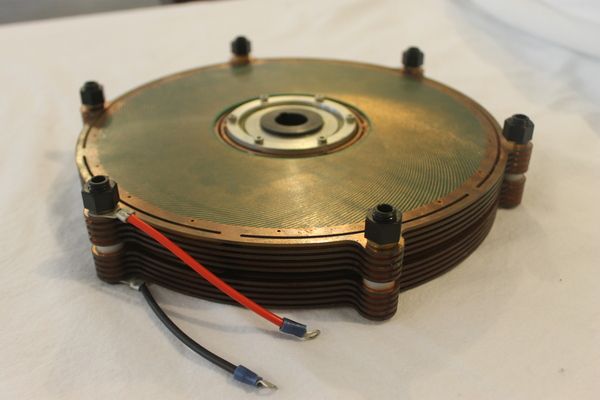
“We have proven the concept of a new motor that uses electric fields rather than magnetic fields to transform electricity into a rotary force,” says company co-founder Dan Ludois, an assistant professor of electrical and computer engineering at the UW. The distinction may sound minor, but it could solve a number of practical problems while saving money, he explains.
Actually, the concept is not entirely new: Benjamin Franklin and others described and built motors based on electrostatic forces back in the 18th and 19th centuries, but none achieved practical operation. Since the widespread adoption of electric motors a century ago, magnetism has been the only practical source of rotation. Magnetism is easier to exploit than electrostatic fields due to the properties of naturally occurring materials and simple engineering techniques. However, new advances in materials, mechanical engineering and advanced manufacturing may enable electrostatic motors.
In 2011, while Ludois was finishing a Ph.D. thesis at UW-Madison, he realized that instead of relying on magnetic fields, he could achieve a similar result by manipulating electric fields to create a motor based on electrostatic attraction. The new technique, he realized, could deliver major advantages in weight, material cost, operating efficiency and maintenance requirements.
For more detail: An Electrostatic Motor
- What principle does the new motor use?
The motor uses electric fields rather than magnetic fields to transform electricity into a rotary force. - Who co-founded the company developing this motor?
Dan Ludois, an assistant professor of electrical and computer engineering at UW-Madison, co-founded C-Motive Technologies. - Why was magnetism used for over a century?
Magnetism was the only practical source of rotation because it is easier to exploit using naturally occurring materials and simple engineering techniques. - Can electrostatic motors operate practically today?
Yes, new advances in materials, mechanical engineering, and advanced manufacturing now enable practical electrostatic motors. - What advantages does this new technique offer?
The technique delivers major advantages in weight, material cost, operating efficiency, and maintenance requirements. - When did the concept for this motor originate?
Ludois realized the concept in 2011 while finishing his Ph.D. thesis at UW-Madison.
