
Summary of DON’T PANIC: A COOPERATIVE BOMB DEFUSING GAME
Heath Paddock created a physical escape room game called "DON'T PANIC," based on "Keep Talking and Nobody Explodes." Two players cooperate to defuse a suitcase bomb within five minutes: one sees the modules, while the other relies on verbal descriptions. The hardware features twice as many hand-wired modules as the original digital game, including an LED maze driven by an Arduino. These modules communicate via a mesh network configured in a loop, allowing for complex cooperative gameplay without visual access to the device's internal state.
Parts used in the DON'T PANIC:
- Arduino
- LED maze module
- Green anchor LEDs
- Blue LED
- Red LED
- Mesh network configuration
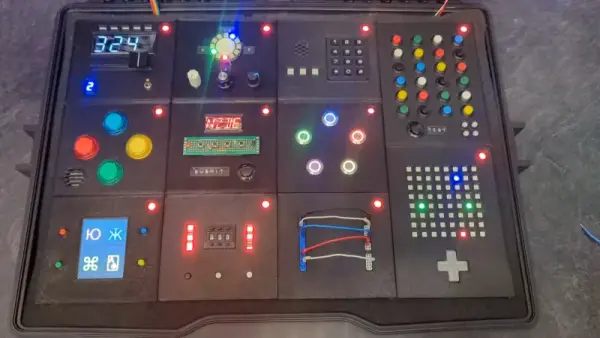
The object is to move the blue LED next to the red one without touching any walls. Of course, the box-holder can’t see the walls and must describe the configuration of the anchor LEDs to their partner in order to get started.
All of the modules are quite different, which likely makes for an extremely fun and challenging five minutes. [Heath] reports that getting inter-module communication down was a long road. Eventually, [Heath] settled on a mesh network configuration and connected everything in a big loop. Be sure to check out the walk-through video after the break.
This isn’t the first time we’ve seen a hardware implementation of this game. Here’s one that uses a Raspberry Pi.
Source: DON’T PANIC: A COOPERATIVE BOMB DEFUSING GAME
- What is the main objective of the game?
The object is to defuse a suitcase bomb within five minutes. - How many players are required to play?
At least two players are needed to play the game. - Does the box-holder know what the walls look like?
No, the box-holder cannot see the walls and must describe the configuration to their partner. - How does the LED maze work in this version?
The goal is to move the blue LED next to the red one without touching any walls. - What technology drives the modules?
Each hand-wired module is driven by an Arduino. - How many modules does Heath's version have compared to the original?
This implementation has twice as many modules as the original game. - What communication method was used for inter-module connectivity?
The creator settled on a mesh network configuration connected in a big loop. - Can the player with knowledge see the bomb?
No, the player holding all the knowledge cannot see the box-bomb.
