
Summary of DARKROOM ROBOT AUTOMATES AWAY THE TEDIUM OF FILM DEVELOPING
This article describes an automated film-developing machine designed to eliminate the tedium of timing solutions in darkrooms. Built by [kauzerei], the device automates chemical flow and agitation using a modified developing tank, pumps, solenoid valves, and a servo motor. It features a strain gauge for precise solution measurement, filtered rinse water, a heated water bath for temperature consistency, and four solution reservoirs to support various processes like black and white or C41 color development.
Parts used in the Automatic Film-Developing Machine:
- Modified developing tank
- Vessels for various solutions
- Pumps
- Solenoid valves
- Servo motor mounted on the tank's cover
- Strain gauge
- Household drinking water pitcher (for filtration)
- Heated water bath
- Four solution reservoirs
Anyone who has ever processed real analog film in a darkroom probably remembers two things: the awkward fumbling in absolute darkness while trying to get the film loaded into the developing reel, and the tedium of getting the timing for each solution just right. This automatic film-developing machine can’t help much with the former, but it more than makes up for that by taking care of the latter.
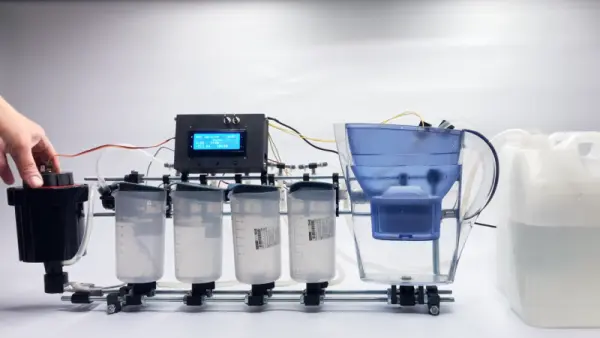
For those who haven’t experienced the pleasures of the darkroom — and we mean that sincerely; watching images appear before your eyes is straight magic — film processing is divided into two phases: developing the exposed film from the camera, and making prints from the film. [kauzerei]’s machine automates development and centers around a modified developing tank and a set of vessels for the various solutions needed for different film processes. Pumps and solenoid valves control the flow of solutions in and out of the developing tank, while a servo mounted on the tank’s cover gently rotates the reel to keep the film exposed to fresh solutions; proper agitation is the secret sauce of film developing.
The developing machine has a lot of other nice features that really should help with getting consistent results. The developing tank sits on a strain gauge, to ensure the proper amount of each solution is added. To avoid splotches that can come from using plain tap water, rinse water is filtered using a household drinking water pitcher. The entire rig can be submerged in a heated water bath for a consistent temperature during processing. And, with four solution reservoirs, the machine is adaptable to multiple processes. [kauzerei] lists black and white and C41 color negative processes, but we’d imagine it would be easy to support a color slide process like E6 too.
This looks like a great build, and while it’s not the first darkroom bot we’ve seen — we even featured one made from Lego Technics once upon a time — this one has us itching to get back into the darkroom again.
Source: DARKROOM ROBOT AUTOMATES AWAY THE TEDIUM OF FILM DEVELOPING
- What problem does this machine solve?
The machine takes care of getting the timing for each solution just right, removing the tedium of manual processing. - How is proper agitation achieved in the machine?
A servo mounted on the tank's cover gently rotates the reel to keep the film exposed to fresh solutions. - How does the machine ensure the proper amount of each solution is added?
The developing tank sits on a strain gauge to measure the correct volume of liquids. - Why is a household drinking water pitcher used in this build?
It filters the rinse water to avoid splotches that can come from using plain tap water. - How does the machine maintain consistent temperature during processing?
The entire rig can be submerged in a heated water bath to ensure consistent temperature. - Can this machine handle different types of film processes?
Yes, with four solution reservoirs, it is adaptable to multiple processes including black and white and C41 color negative. - Does the machine automate making prints from the film?
No, the machine automates development but does not help with making prints from the film. - What are the two phases of film processing mentioned in the text?
The two phases are developing the exposed film from the camera and making prints from the film.
