
Summary of LED TESTER ALSO CALCULATES RESISTOR FOR TARGET VOLTAGE
This article describes an LED tester built by [mircemk] that allows users to select target current and voltage. The device calculates the required series resistor for the chosen voltage, displays forward voltage, current, and calculated resistance on an LCD, and helps empirically determine brightness without a full test setup.
Parts used in the LED Tester:
- Arduino
- LCD display
- Buttons
- Passive components
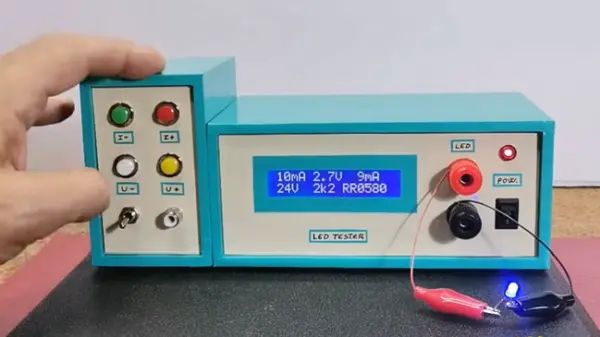
The buttons on the left control the target current and the voltage of the destination system. Once an LED is connected it will light up and the display indicates the LED’s forward voltage, the LED current, and the calculated series resistor value to obtain the same result at the selected target voltage. It’s a handy way to empirically dial in LED brightness values without needing to actually set up any particular test environment.
On the inside there’s little more than a handful of passive components, an Arduino, an LCD display, and a few buttons. This kind of tool reminds us of the highly clever component testers that hit the hobbyist scene years ago, showing what kind of advanced tricks a modern microcontroller is capable of with the right programming. (Here’s a look at how those work, if you’re interested in some deeper details.)
Source: LED TESTER ALSO CALCULATES RESISTOR FOR TARGET VOLTAGE
- How does the system handle target voltage?
The system automatically calculates the necessary series resistor based on the provided target voltage. - What functions do the buttons control?
The buttons on the left control the target current and the voltage of the destination system. - What information does the display indicate after connecting an LED?
The display indicates the LED's forward voltage, the LED current, and the calculated series resistor value. - Can this tool help dial in LED brightness values?
Yes, it is a handy way to empirically dial in LED brightness values without needing to set up any particular test environment. - What internal components make up the device?
Inside there are passive components, an Arduino, an LCD display, and a few buttons. - Does the device show how the LED looks at the chosen current?
Yes, if the LED is destined for a specific voltage like 14 V, the device shows how the LED looks at the chosen current. - Why is the enclosure design mentioned as important?
The attention paid to the enclosure demonstrates that it is never too early to consider enclosure and UI layout when designing something. - What kind of tricks does this tool demonstrate about microcontrollers?
It shows what kind of advanced tricks a modern microcontroller is capable of with the right programming.
