
Summary of FRAMEWORK MOTHERBOARD TURNED CYBERDECK
Ben repurposed a Framework laptop motherboard and battery to build a slab-style cyberdeck with a 2400×900 USB-C IPS display, Apple keyboard, PS2 optical trackball (via an Arduino Pro Micro PS2-to-USB adapter), machined aluminum plates, and 3D-printed spacers, retaining multiple USB-C ports for expansion and peripherals.
Parts used in the Framework motherboard turned cyberdeck:
- Framework motherboard
- Framework battery
- 2400 x 900 IPS USB-C display
- Apple keyboard
- Optical trackball with PS2 interface
- Arduino Pro Micro (used as PS2-to-USB adapter and general I/O)
- USB hub
- External USB connector
- External HDMI connector
- Machined aluminum plates (enclosure)
- 3D printed spacers
The beauty of a modular ecosystem lies in how it allows individuals to repurpose components in unconventional ways. This is precisely what [Ben Makes Everything] has achieved by using a Framework laptop’s motherboard and battery to create a slab-style cyberdeck. (Video, embedded below.)
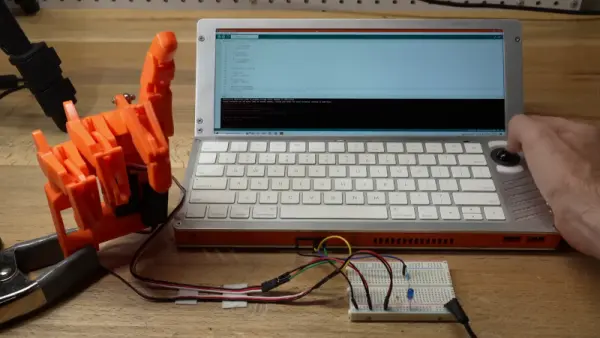
The Framework motherboard presents an excellent choice for custom portable computer projects due to its relatively compact size and built-in modular I/O port options, all based on USB-C. Framework even released additional documentation to support this use-case. It’s significantly more powerful than the standard Raspberry PI, which is typically employed in similar projects. Ben chose a 2400 x 900 IPS display that can draw power and video through a single USB-C cable. For user input, he opted for an Apple keyboard and an optical trackball with a PS2 interface. He utilized a Arduino Pro Micro as a PS2-to-USB adaptor, using the remaining pins on the Arduino as a versatile interface for electronic projects.
The enclosure is crafted from machined aluminum plates with 3D printed spacers to secure all components. The screen can be tilted up to 45 degrees for more ergonomic desktop use. The Framework motherboard is equipped with four USB-C ports for peripheral devices; [Ben] allocated one for the display and another for a USB hub which connects the keyboard, Arduino, and external USB and HDMI connectors. The remaining USB-C ports are still available for original Framework expansion cards.
The completed project not only looks fantastic but may also be highly functional. It would have been a great entry in our recent Cyberdeck Challenge.
Source: FRAMEWORK MOTHERBOARD TURNED CYBERDECK
- What motherboard was used to build the cyberdeck?
The Framework motherboard was used. - Can the chosen display receive power and video over a single cable?
Yes, the 2400 x 900 IPS display draws power and video over a single USB-C cable. - How is the PS2 optical trackball connected to the system?
The PS2 optical trackball is connected via an Arduino Pro Micro acting as a PS2-to-USB adapter. - What material was used for the enclosure?
The enclosure is made from machined aluminum plates with 3D printed spacers securing components. - Does the build retain Framework expansion options?
Yes, the Framework motherboard retains USB-C ports and remaining ports are available for original Framework expansion cards. - What is the purpose of the Arduino Pro Micro aside from PS2-to-USB conversion?
The Arduino Pro Micro also uses its remaining pins as a versatile interface for electronic projects. - How many USB-C ports does the Framework motherboard provide for peripherals?
It provides four USB-C ports for peripheral devices. - Which peripherals are connected through the USB hub?
The USB hub connects the keyboard, Arduino, and external USB and HDMI connectors.
