
Summary of AUTO XYLOPHONE USES HOMEMADE SOLENOIDS
[Rachad] built an automatic xylophone that uses 24 homemade solenoids to strike bars under Arduino control, converting MIDI files into serial commands to play tunes; coils were wound on nails and glued (hot curling iron used as a glue tool), and the creator plans future AI to read sheet music. The instrument sounds good despite DIY materials and striker placement.
Parts used in the Automatic Xylophone:
- 24 homemade solenoids (coils of wire wound on nails)
- Nails (used as solenoid plungers/cores)
- Wire for coils
- Hot glue (applied using a curling iron as a tool)
- Arduino (reads serial output to drive solenoids)
- Computer toolchain to convert MIDI files to serial output
- Xylophone bars (instrument bars to be struck)
- Power supply for solenoids and electronics
- Driver circuitry or relays to switch solenoids (implied for control)
Want to play the xylophone but don’t want to learn how? [Rachad]’s automatic xylophone might be just the ticket. It uses homemade solenoids to play tunes under computer control. Think of it as a player piano but with electromagnetic strikers instead of piano keys. You can hear the instrument in action in the video below.
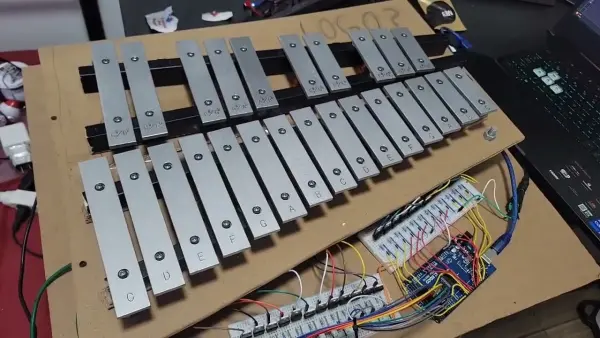
Since the project required 24 solenoids, [Rachad] decided to build custom ones using coils of wire and nails. We were amused to see a common curling iron used as an alternate way to apply hot glue when building the coils. The other interesting part of the project was the software. He now uses a toolchain to convert MIDI files into a serial output read by the Arduino. Eventually, he wants to train an AI to read sheet music, but that’s down the road, apparently.
Honestly, we were a bit surprised that it sounded pretty good because we understand that the material used to strike the xylophone and the exact position of the strike makes a difference. We doubt any orchestra will be building one of these, but it doesn’t sound bad to us.
The last one of these we saw did have more conventional strikers if you want to compare. Honestly, we might have just bought the solenoids off the shelf but, then again, we don’t make our own relays either.
Source: AUTO XYLOPHONE USES HOMEMADE SOLENOIDS
- How many solenoids does the project require?
The project requires 24 solenoids. - How are the solenoids constructed?
The solenoids are homemade by winding coils of wire around nails. - What unconventional tool was used when building the coils?
A common curling iron was used as an alternate way to apply hot glue. - How does the system get music data to the Arduino?
A toolchain converts MIDI files into a serial output that the Arduino reads. - What does the creator plan to develop in the future?
The creator plans to train an AI to read sheet music in the future. - What replaces piano keys in this player-piano style instrument?
Electromagnetic strikers (solenoids) replace piano keys. - Does the article say how the instrument sounds?
The article says it sounded pretty good despite DIY materials and striker placement. - Are off-the-shelf solenoids mentioned as an alternative?
The article notes one might buy solenoids off the shelf instead of making them.
