
Summary of Single Digit Numitron Clock
This article details the construction of a retro-style digital clock using six Russian IV-9 Numitrons, which are low-voltage incandescent displays. The project utilizes a PIC16F84A microcontroller running modified software originally designed for LED displays to manage timekeeping and digit flashing. The circuit leverages the microcontroller's I/O capabilities to drive the filaments directly without complex drivers, noting specific current limits per port.
Parts used in the Numitron Clock:
- Six IV-9 Russian Numitrons
- PIC 16F84A microcontroller
- 4MHz crystal oscillator
- Breadboard (for testing)
- Eagle schematic files
Numitrons are neat display devices similar to nixie tubes but designed for much lower voltages. Numitrons are basically incandescent displays in which filaments create the segments.
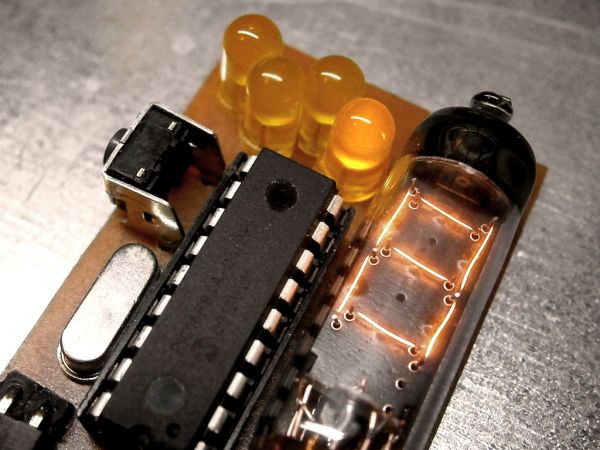
They have a retro look that I liked so much. I bought 6x IV-9 Russian Numitrons in eBay, they were about 3$ each, they’re pretty cheap!
At that time I didn’t know what to do with them, but then I thought about a clock. Using software from a single LED display clock I made this impressive numitron clock.
Step 1: Program the PIC
The original purpose of the software was to drive a single common-anode LED display rather than a numitron, but either way works.
The software was modified to flash the digits so the HHMM LEDs wouldn’t be necessary. Also the software was modified so if the tens of hours is 0 then it is not displayed.
Moreover, the software does not check the input values so entering the wrong time such as 67:85 would be accepted, but eventually the clock will start resetting the digits correctly.
The clock operates off a PIC 16F84A using a program written by David Tait (software is further down this page). The crystal oscillator for the clock is a 4MHz crystal.
I think another microcontroller such as PIC16F628A could also work fine.
Step 2: The circuit
After testing on the breadboard, the clock works fine, with the current crystal the clock comes forward a minute each 3 days, with a precision one it can be solved, but it’s good enough for me; because setting time is easy.
You can see the test video below and download the eagle schematic to modify it.
Since numitron displays are just complex bulbs, it could be a problem to drive them from the processor, but in this case, it’s not a problem:
The PIC16F84A can source or sink 25mA per I/O pin.
But each port has a limit:
Maximum current sunk by PORTA-80 mA
Maximum current sourced by PORTA-50 mA
Maximum current sunk by PORTB-150 mA
Maximum current sourced by PORTB-100 mA
With IV-9/IV-16 each segment draws 20mA, but be careful if you choose another numitron!
For more detail: Single digit numitron clock
- What type of display devices are Numitrons?
Numitrons are incandescent displays where filaments create the segments and operate at much lower voltages than nixie tubes. - Which microcontroller is used in this clock project?
The clock operates off a PIC 16F84A microcontroller. - Can other microcontrollers be used instead of the PIC16F84A?
Yes, the author suggests that another microcontroller such as the PIC16F628A could also work fine. - How much current does each segment of an IV-9 or IV-16 numitron draw?
Each segment draws 20mA. - What is the maximum current sourced by PORTB on the PIC16F84A?
The maximum current sourced by PORTB is 100 mA. - How precise is the clock with the standard 4MHz crystal?
With the current crystal, the clock comes forward a minute every three days. - Does the software validate input time values like 67:85?
No, the software does not check input values so entering wrong times is accepted initially until the clock resets them correctly. - What modification was made to the original software?
The software was modified to flash digits so HHMM LEDs were unnecessary and to suppress the leading zero for the tens of hours.
