
Summary of LINUX, RUNNING ON NOT A LOT
Naveen built an ultra-low-power Linux-capable device using an ESP32 (Xtensa core) running an MMU-less, microcontroller-focused Linux variant. Stacked on an Arduino UNO with I2C keyboard and display, the tiny system emphasizes minimal electrical consumption over performance, offering a lightweight alternative to platforms like the Raspberry Pi Zero. The project highlights trade-offs between full-featured Linux and severely constrained embedded implementations, and points to the Xtensa Linux port for more detail.
Parts used in the ESP32 Xtensa Linux Project:
- ESP32 Arduino-sourced board (Xtensa core)
- Arduino UNO (stacked)
- I2C keyboard
- I2C display
- Power supply/battery (implied for low-power operation)
There are many possible answers to the question of what the lowest-powered hardware on which Linux could run might be, but it’s usually a pre-requisite for a Linux-capable platform to have a memory management unit, or MMU. That’s not the whole story though, because there are microcontroller-focused variants of the kernel which don’t require an MMU, including one for the Xtensa cores found on many Espressif chips. It’s this that [Naveen] is using to produce a computer which may not be the Linux computer with the lowest processor power, but could be the one consuming the least electrical power.
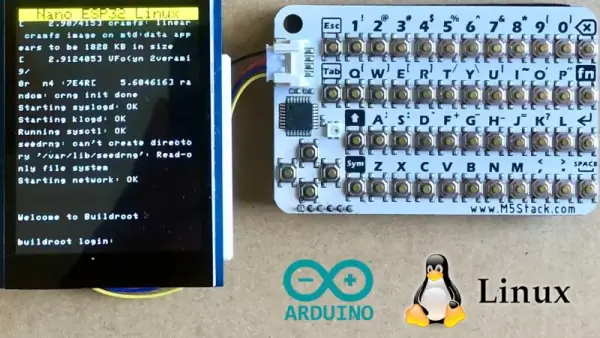
The result is definitely not a Linux powerhouse, but with its Arduino-sourced ESP32 board stacked on an UNO and I2C keyboard and display, it’s an extremely lightweight device. The question remains, though, is it more than a curiosity, and to what can it do? The chief advantage it has over its competitors such as the Raspberry Pi Zero comes in low power consumption, but can its cut-down Linux offer as much as a full-fat version? We are guessing that some commenters below will know the answer.
If you’re curious about the Xtensa version of Linux, it can be found here,
Source: LINUX, RUNNING ON NOT A LOT
- Can Linux run on very low-powered hardware like the ESP32?
Yes, a microcontroller-focused variant of Linux that does not require an MMU can run on Xtensa cores like the ESP32. - Does the ESP32 project use a standard Linux kernel?
It uses an MMU-less, microcontroller-focused variant of Linux for the Xtensa architecture rather than a full standard desktop kernel. - What components make up the lightweight Linux computer?
An ESP32 board, an Arduino UNO for stacking, an I2C keyboard, and an I2C display. - Is the goal of the project low power consumption?
Yes, the chief advantage highlighted is lower electrical power consumption compared to alternatives like the Raspberry Pi Zero. - Is this ESP32-based system a performance powerhouse?
No, the result is not a Linux powerhouse; it is extremely lightweight and limited in capability. - How does this device compare to Raspberry Pi Zero?
The project emphasizes lower power consumption, but it likely offers fewer features and less performance than a full Raspberry Pi Zero. - Where can I find the Xtensa version of Linux used in the project?
The article points to the Xtensa version of Linux and provides a link to it for further information.
