
Summary of BEHOLD A GALLERY OF SONY’S PS VR2 PROTOTYPES
Sony shared an interview and images of PlayStation VR2 prototypes, showing many iterations focused on specific functions like camera placement and controller ergonomics. Prototypes ranged from ungainly testing rigs to near-final designs. Controllers evolved significantly and include PS5-style adaptive triggers offering variable resistance and unique force feedback. The reveal highlights the extensive effort and multiple specialized prototypes required to develop modern VR hardware, even when using existing modules.
Parts used in the PlayStation VR2 Prototypes:
- Prototype headset shells for camera placement testing
- Camera modules for tracking evaluation
- Optical sensors/lenses
- Controller housings for ergonomic testing
- Adaptive trigger mechanisms (PS5-style)
- Force feedback/active haptics components
- Internal electronic modules and PCBs
- Mounting and support rigs for prototype assembly
Every finished product stands at the end of a long line of prototypes, and Sony have recently shared an interview and images of their PlayStation VR2 prototypes.
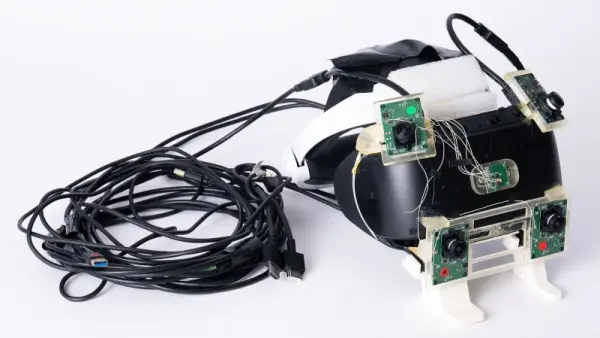
Many of the prototypes focus on a specific functionality, and readers who are not familiar with building things might find it a bit wild to see just how big and ungainly un-optimized hardware can be.
The images are definitely the best part of that link, but the interview has a few interesting bits. For example, one prototype was optimized for evaluating and testing camera placement with a high degree of accuracy, and it hardly looks like a VR headset at all.
The controllers on the other hand seem to have gone though more iterations based on the ergonomics and physical layout of controls. The VR2 controllers integrate the adaptive triggers from the PlayStation 5, which are of a genuinely clever design capable of variable resistance as well as an active force feedback effect that’s not quite like anything that’s come before.
There’s a lot of work that goes into developing something like a VR headset, as we see here and we’ve seen with Facebook’s (now Meta) VR research prototypes. But even when one can leverage pre-made modules as much as possible and doesn’t need to start entirely from scratch, making a VR headset remains a whole heap of work.
Source: BEHOLD A GALLERY OF SONY’S PS VR2 PROTOTYPES
- What did Sony share about PlayStation VR2 prototypes?
Sony shared an interview and images showing multiple PS VR2 prototypes focused on different functionalities. - Why do some prototypes look ungainly?
Many prototypes are un-optimized hardware built to test specific functions, making them large and ungainly. - What was one prototype optimized for?
One prototype was optimized for evaluating and testing camera placement with high accuracy. - How did the controllers evolve through prototypes?
Controllers went through more iterations focused on ergonomics and physical control layout. - Do the VR2 controllers include adaptive triggers?
Yes, the VR2 controllers integrate the adaptive triggers from the PlayStation 5. - What do the adaptive triggers provide?
Adaptive triggers offer variable resistance and an active force feedback effect. - Does building a VR headset require a lot of work?
Yes, developing a VR headset requires extensive work and many specialized prototypes, even when using pre-made modules. - Are there similarities with other companies' research prototypes?
Yes, the PS VR2 prototype process resembles other VR research prototypes such as Meta's earlier work.
