
Summary of PUNCHED CARDS ARE IN THE CLOUD, WITH THIS ARDUINO
Grizzled veterans will relate stories of punched-card development; Nino Ivanov built a basic punched-card reader using LEDs, light sensors, and an Arduino Uno. The Uno reads cards and sends serial data to a tablet, which forwards it to a cloud LISP interpreter; each card stores a 23-character LISP program. The project blends vintage media with modern cloud execution, demonstrating compact code on minimalist punched cards.
Parts used in the Punched Card Reader project:
- Arduino Uno
- LEDs (for illuminating card holes)
- Light sensors (photodiodes or photoresistors to detect holes)
- Wiring and connectors
- USB cable (for serial connection to tablet)
- Tablet (to receive serial data)
- Cloud LISP interpreter API/service
- Punched cards (custom cards with 23-character programs)
Grizzled veterans of the computing industry will relate stories of submitting projects on stacks of punched cards, something those of us who stored their 8-bit works on audio cassettes could only imagine. But for those who fancy experimenting with the format it’s still possible to make a basic card reader using LEDs and light sensors, as [Nino Ivanov] has done using an Arduino Uno as the brains. And these aren’t just for show, each of his cards holds a LISP program that runs in a cloud service.
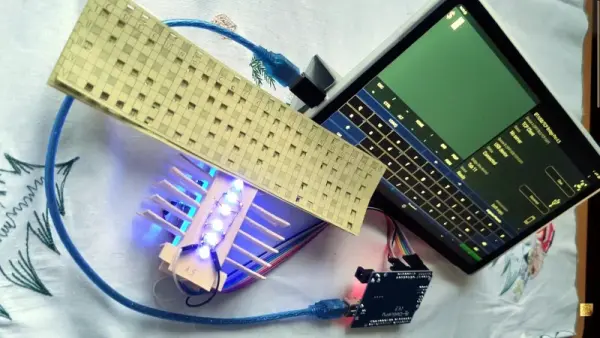
The Uno does the job of reading, passing its data over its USB serial port to a tablet. On the tablet the serial data is piped to a cloud API to a LISP interpreter. It seems a needlessly complex way to run a factorial program and it’s certainly a little over the top, but on the other hand we love it as a glorious combination of the old and the new. With only 23 characters per card it’s quite an impressive feat to even fit a program on the format, perhaps writing code to fit on minimalist punched cards like this could become a programming challenge in its own right for a generation accustomed to mega-and gigabytes.
If you fancy a go yourself, this isn’t the first punched card reader we’ve shown you.
Source: PUNCHED CARDS ARE IN THE CLOUD, WITH THIS ARDUINO
- What hardware reads the punched cards?
An Arduino Uno reads the punched cards using LEDs and light sensors. - How is data sent from the reader to run the programs?
The Uno sends serial data over USB to a tablet, which pipes it to a cloud LISP interpreter API. - What language do the cards contain?
Each card holds a LISP program. - How many characters fit on each card?
Each card holds 23 characters. - Does the project run programs locally on the Arduino?
No; the Arduino only reads and transmits data, the LISP interpreter runs in the cloud via the tablet. - What components detect holes in the cards?
LEDs illuminate the cards and light sensors detect the presence of holes. - Is a tablet required for the setup?
Yes; the tablet receives serial data from the Arduino and forwards it to the cloud service. - Can this setup run complex programs?
The article demonstrates small LISP programs (23 characters), implying limited program size on these cards.
