
Summary of AN OPEN HARDWARE AUTOMATIC SPINNING MACHINE
Studio HILO developed an open-source desktop spinning machine for interactive yarn production. The frame uses 3030 aluminum extrusions, while motion is driven by NEMA 17 stepper motors controlled via an Arduino Mega 2560 and RAMPS 1.4 board. The user interface runs on Processing software. While documentation is excellent, the project requires a high-precision polyjet or multi-material 3D printer for specific drive wheels, though alternatives may exist.
Parts used in the Open Hardware Automatic Spinning Machine:
- 3030 profile aluminium extrusions
- 3D printed parts
- Laser cut parts
- NEMA 17 stepper motors
- Arduino Mega 2560
- RAMPS 1.4 board
- Polyjet or accurate multi-material 3D printer (for drive wheels)
- Carder (optional for raw fibers)
The team at the Berlin-based Studio HILO has been working on ideas and tools around developing a more open approach to small-scale textile production environments. Leveraging open-source platforms and tools, the team has come up with a simple open hardware spinning machine that can be used for interactive yarn production, right on the desktop. The frame is built with 3030 profile aluminium extrusions, with a handful of 3D printed, and a smidge of laser cut parts. Motion is thanks to, you guessed it, NEMA 17 stepper motors and the once ubiquitous Arduino Mega 2560 plus RAMPS 1.4 combination that many people will be very familiar with.
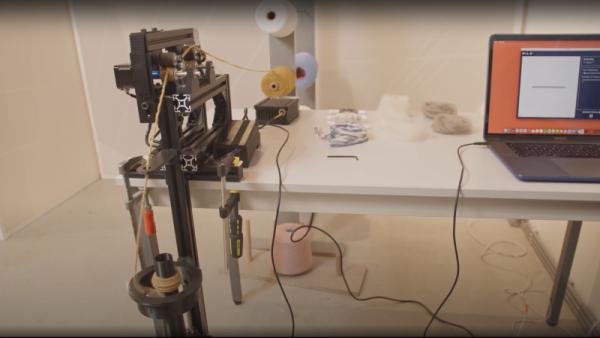
The project really shines on the documentation side of things, with the project GitLab positively dripping with well-organised information. One minor niggle is that you’ll need access to a polyjet or very accurate multi-material 3D printer to run off the drive wheel and the associated trailing wheel. We’re sure there’s a simple enough way to do it without those tools, for those sufficiently motivated.
We liked the use of Arduino for the firmware, keeping things simple, and in the same vein, Processing for the user interface. That makes sending values from the on-screen slider controls over the USB a piece of cake. Processing doesn’t seem to pop up on these pages too often, which is a shame as it’s a great tool to have at one’s disposal. On the subject of the user interface, it looks like for now only basic parameters can be tweaked on the fly, with some more subtle parameters needing fixing at firmware compilation time. With a bit more time, we’re sure the project will flesh out a bit more, and that area will be improved.
Of course, if you only have raw fibers, that are not appropriately aligned, you need a carder, like this one maybe?
Source: AN OPEN HARDWARE AUTOMATIC SPINNING MACHINE
- What is the primary purpose of the Studio HILO project?
The team created an open hardware spinning machine for interactive yarn production on a desktop. - How is the motion system powered in this project?
Motion is provided by NEMA 17 stepper motors. - Which microcontroller and control board are used?
The project utilizes an Arduino Mega 2560 combined with a RAMPS 1.4 board. - What software is used for the user interface?
Processing is used to create the user interface and send values from slider controls via USB. - Can users adjust all parameters on the fly?
Currently only basic parameters can be tweaked on the fly; some subtle parameters require firmware compilation changes. - What type of 3D printer is needed for the drive wheels?
You need access to a polyjet or very accurate multi-material 3D printer to run off the drive wheel. - What material is used to build the machine frame?
The frame is built with 3030 profile aluminium extrusions. - What tool might be needed if you have raw fibers that are not aligned?
You might need a carder to align raw fibers before spinning.
