
Summary of BBC MICRO:BIT AS HANDHELD SYNTHESIZER
The BBC Micro:bit serves as a unique platform for a handheld synthesizer project, leveraging its built-in LED matrix and gyro sensor. The creator designed a 5×5 button matrix paired with diodes to prevent false inputs, while the gyro controls pitch detuning based on device orientation. A passive low-pass filter ensures the sound is pleasant for all users. Although functional, the developer noted that using C instead of MicroPython would offer better control and fewer complications for future enhancements.
Parts used in the Handheld Synthesizer:
- BBC Micro:bit
- LED matrix
- Gyro sensor
- 5×5 button matrix
- Diodes
- Passive low-pass filter
The BBC Micro:bit, while not quite as popular in our community as other microcontroller development boards, has a few quirks that can make it a much more interesting piece of hardware to build a project around than an Arduino. [Turi] took note of these unique features and decided that it was the perfect platform to build a synthesizer on.
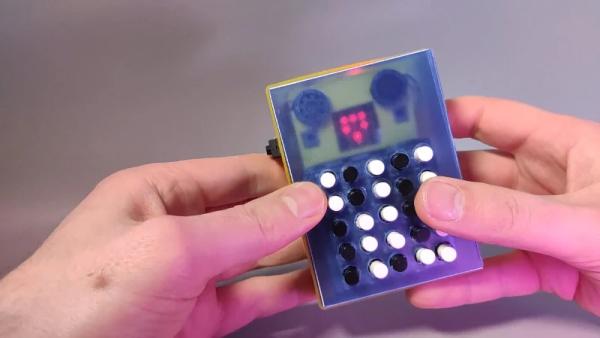
The Micro:bit includes two important elements that make this project work: the LED matrix and a gyro sensor. [Turi] built a 5×5 button matrix for inputs and paired each to one of the diodes, which eliminates the problem of false inputs. The gyro sensor is used for detuning, which varies the pitch of any generated sound by a set amount according to the orientation of the device. It also includes a passive low-pass filter to make the sound more pleasant to the ear, especially for younger players of the machine. He’s released the source code on his GitHub page for anyone interested in recreating it.
While this was a one-off project for [Turi], he notes that using MicroPython to program it instead of C led to a lot of unnecessary complications, and the greater control allowed by C would enable some extra features with less hassle. Still, it’s a fun project that really showcases the unique features of this board, much like this tiny Sumo robot we covered over the summer
Source: BBC MICRO:BIT AS HANDHELD SYNTHESIZER
- Why did the creator choose the Micro:bit over an Arduino?
The board has unique quirks like an LED matrix and gyro sensor that make it interesting for building a synthesizer. - How does the device handle input to avoid errors?
A 5×5 button matrix was paired with diodes to eliminate the problem of false inputs. - What function does the gyro sensor serve in this project?
The gyro sensor is used for detuning, which varies the pitch of generated sounds based on device orientation. - How can the sound be made more pleasant for younger players?
A passive low-pass filter is included to improve the audio quality for younger listeners. - Where can I find the source code to recreate this project?
The source code is released on the creator's GitHub page. - Which programming language caused unnecessary complications in this build?
Using MicroPython led to complications compared to the greater control offered by C. - What advantage does C provide over MicroPython for this project?
C allows for extra features to be added with less hassle due to greater control. - Is this synthesizer design intended for mass production?
No, the creator notes that this was a one-off project.
