
Summary of BRING PRECISION TO THE WOODSHOP WITH AN ELECTRONIC ROUTER LIFT
This article describes an electronic router lift project designed to improve precision in woodworking by automating height adjustments. The build integrates a commercial router lift with a NEMA 23 stepper motor and an Arduino controller. Key features include rapid jog controls, a fine adjustment encoder, and a contact sensor using magnetic probes for touch-off calibration. While the author praises the design for bridging mechatronics and woodworking, they note potential dust issues for the stepper motor.
Parts used in the Electronic Router Lift:
- Commercially available router lift
- Plunge router
- NEMA 23 stepper motor
- Arduino controller
- Rapid jog control mechanism
- Fine adjustment encoder
- Contact sensor
- Magnetic probes
- Height gauge
One of the knocks that woodworkers get from the metalworking crowd is that their chosen material is a bit… compliant. Measurements only need to be within a 1/16th of an inch or so, or about a millimeter, depending on which side of the Atlantic you’re on. And if you’re off a bit? No worries, that’s what sandpaper is for.
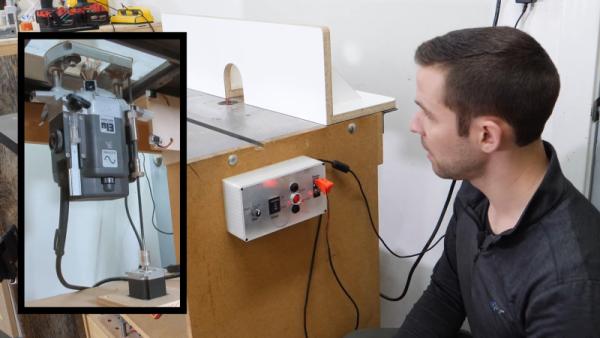
This electronic router lift is intended to close the precision gap and make woodworking a bit less subjective. [GavinL]’s build instructions are clearly aimed at woodworkers who haven’t dabbled in the world of Arduinos and stepper motors, and he does an admirable job of addressing the hesitancy this group might feel when tackling such a build. Luckily, a lot of the mechanical side of this project can be addressed with a commercially available router lift, which attaches to a table-mounted plunge router and allows fine adjustment of the cutting tool’s height from above the table.
What’s left is to add a NEMA 23 stepper to drive the router lift, plus an Arduino to control it. [GavinL] came up with some nice features, like a rapid jog control, a fine adjustment encoder, and the ability to send the tool all the way up or all the way down quickly. Another really nice touch is the contact sensor, which is a pair of magnetic probes that attach temporarily to the tool and a height gauge to indicate touch-off. Check the video below to see it all in action.
One quibble we have with [GavinL]’s setup is the amount of dust that the stepper will be subjected to. He might need to switch out to a dustproof stepper sooner rather than later. Even so, we think he did a great job bridging the gap between mechatronics and woodworking — something that [Matthias Wandel] has been doing great work on, too.
Source: BRING PRECISION TO THE WOODSHOP WITH AN ELECTRONIC ROUTER LIFT
- What is the primary purpose of this electronic router lift?
To close the precision gap in woodworking and make measurements less subjective. - Can woodworkers without experience in Arduinos or stepper motors use these instructions?
Yes, the build instructions are clearly aimed at that group and address their hesitancy. - How does the system achieve fine height adjustments?
A NEMA 23 stepper drives the router lift while an Arduino controls it via a fine adjustment encoder. - What features allow for quick tool movement?
The setup includes a rapid jog control and the ability to send the tool all the way up or down quickly. - How does the contact sensor function in this project?
It uses a pair of magnetic probes attached temporarily to the tool and a height gauge to indicate touch-off. - What is a potential drawback regarding the stepper motor mentioned in the article?
The stepper will be subjected to a significant amount of dust and may need to be switched out for a dustproof version. - Does the article mention any other individuals working on similar projects?
Yes, it notes that Matthias Wandel has been doing great work bridging the gap between mechatronics and woodworking. - What type of router is compatible with the commercially available lift described?
A table-mounted plunge router attaches to the lift for fine adjustment of the cutting tool's height.
