
Summary of BRINGING THE POWER OF EDM TO THE HOME SHOP
This article details a DIY wire EDM machine project by [Action BOX] aimed at bringing precision metal cutting to home shops. The build focuses on a complex wire-handling mechanism using 3D-printed parts, rollers, and bearings to manage tension via servo-controlled brakes and strain gauges. Although the prototype faced challenges with wire breakage and no actual cuts were achieved, the project demonstrates significant potential for future development in home-based electrical discharge machining.
Parts used in the DIY Wire EDM Machine:
- Fine brass wire
- Dielectric bath
- Supply spool
- Takeup spool
- 3D-printed parts
- Rollers
- Bearings
- Servo-controlled brake
- Closed-loop stepper motor
- Strain gauges
- Arduinos
When you see something made from metal that seems like it would be impossible to manufacture, chances are good it was made with some variety of electrical discharge machining. EDM is the method of choice for hard-to-machine metals, high aspect ratio hole drilling, and precise surface finishes that let mating parts slip together with almost zero clearance. The trouble is, EDM is a bit fussy, and as a result hasn’t made many inroads to the home shop.
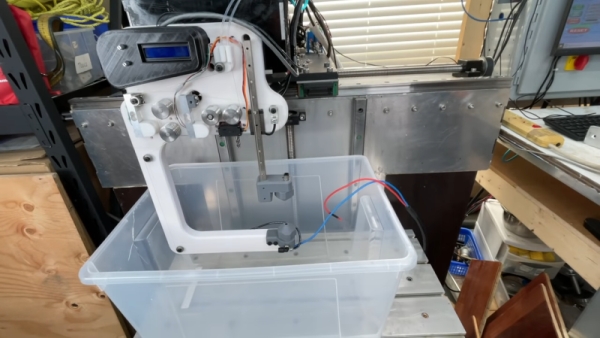
[Action BOX] aims to change that with a DIY wire EDM machine. In wire EDM, a fine brass wire is used as an electrode to slowly erode metal in a dielectric bath. The wire is consumable, and has to constantly move from a supply spool through the workpiece and onto a takeup spool. Most of the build shown in the video below is concerned with the wire-handling mechanism, which is prototyped from 3D-printed parts and a heck of a lot of rollers and bearings. Maintaining the proper tension on the wire is critical, so a servo-controlled brake is fitted to the drivetrain, which itself is powered by a closed-loop stepper. Tension is measured by a pair of strain gauges and Arduinos, which control the position of the shaft brake servo and the speed of the motor on the takeup spool.
Unfortunately, in testing this setup proved to live up to EDM’s fussy reputation. The brass wire kept breaking as soon as cutting started, and [Action BOX] never made any actual cuts. There’s certainly promise, though, and we’re looking forward to developments. For more on EDM theory, check out [Ben Krasnow]’s look at EDM hole-drilling.
Source: BRINGING THE POWER OF EDM TO THE HOME SHOP
- What is the primary purpose of the DIY wire EDM machine described?
To bring the power of electrical discharge machining to the home shop. - How does wire EDM erode metal according to the article?
A fine brass wire acts as an electrode to slowly erode metal in a dielectric bath. - What components are used to maintain proper wire tension?
A servo-controlled brake fitted to the drivetrain and measured by a pair of strain gauges. - Which microcontroller controls the wire handling system?
Arduinos control the position of the shaft brake servo and the speed of the takeup spool motor. - What type of motor powers the drivetrain in this build?
A closed-loop stepper motor powers the drivetrain. - Why has EDM not made many inroads to the home shop previously?
Because EDM is considered a bit fussy to operate. - What specific problem occurred during testing of the setup?
The brass wire kept breaking as soon as cutting started. - Did the project achieve any actual cuts during its initial testing phase?
No, the builder never made any actual cuts before the wire broke.
