
Summary of MECHANICAL MUSICAL SCULPTURE RECALLS THE FOUR MUSES
### Summary Alana Balagot and Federico Tobon created the "4 Muses," a musical sculpture featuring four distinct instruments controlled by a single keyboard. This system functions as a live performer, sequencer, or playback device. The ensemble includes a pipe organ with servo valves, a xylophone using solenoids, a mechanized cajón drum driven by motors, and a motor-noise instrument utilizing stepper motors. The project relies on various microcontrollers like Arduino Megas, Teensys, and NRF24s for wireless communication and control, blending electronics with exquisite wood finishes to create a unique artistic performance piece.
Parts used in the 4 Muses:
- Single keyboard controller
- Servo-controlled valves
- Blower fan
- Wood pipes
- Solenoids
- 13 tines (xylophone)
- Mechanized cajón drum
- Motors (for mallet actuation)
- Stepper motors
- Arduino Mega microcontrollers
- Teensy microcontrollers
- NRF24 wireless transceivers
- Brass hardware
- Exquisite wood finishes
Music was created by humans, but often we find ourselves creating performances with machines. [Alana Balagot] and [Federico Tobon] did just that, constructing the stunning 4 Muses musical sculpture with their combined talents.
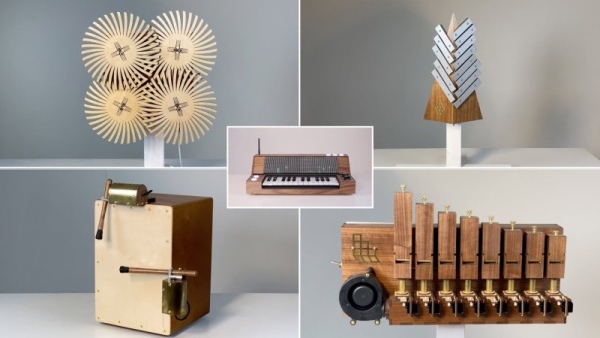
4 Muses is made up of four individual instruments, under the command of a single keyboard controller. The keyboard can be used to play the instruments live, or alternatively, can learn from the player or be used as a sequencer. It can also act as a simple device to play back music using the four instruments.
The pipe instrument uses servo-controlled valves, which allow air from a blower fan to reach several wood pipes. The xylophone instead uses solenoids to play its 13 tines. Percussion is provided by a mechanized cajón drum, using motors to actuate mallets that strike the various sections of the box. Meanwhile, hackers will be familiar with the concept of the motor-noise instrument, which drives stepper motors at different frequencies to generate tones.
Inside, a cavalcade of microcontrollers make everything work, from Arduino Megas and Teensys to NRF24s sending wireless packets from the controller to the instruments. [Alana] and [Federico] go in-depth with their documentation, highlighting the challenges they faced putting together the various instruments and showing how the final build came together.
Built with and brass hardware and sporting a variety of exquisite wood finishes, the final result is a quartet of machines that play beautiful music composed by [Alana] herself. Musical sculptures are often a great example of the artistry possible when putting electrons to work. Video after the break.
Source: MECHANICAL MUSICAL SCULPTURE RECALLS THE FOUR MUSES
- What components make up the pipe instrument?
The pipe instrument uses servo-controlled valves that allow air from a blower fan to reach several wood pipes. - How does the xylophone generate sound?
The xylophone uses solenoids to play its 13 tines. - What mechanism drives the percussion section?
A mechanized cajón drum uses motors to actuate mallets that strike the various sections of the box. - How is the motor-noise instrument constructed?
This instrument drives stepper motors at different frequencies to generate tones. - Which microcontrollers are used inside the sculpture?
The build utilizes a cavalcade of microcontrollers including Arduino Megas, Teensys, and NRF24s. - Can the keyboard controller be used as a sequencer?
Yes, the keyboard can learn from the player or be used as a sequencer. - How do the instruments communicate with the controller?
NRF24s send wireless packets from the controller to the individual instruments. - Who composed the music played by the sculpture?
The beautiful music is composed by Alana Balagot.
