
Summary of Ambient light includes IR sensor for mobiles proximity detection
The MAX44000 is a compact BiCMOS IC integrating an ambient light sensor and an IR proximity detector for portable devices. It features a wide dynamic range (0.03 to 65,535 lux), programmable green and IR channel gains, and an internal IR LED driver. Operating on 1.7V to 3.6V, it consumes ultra-low power as low as 5µA in ambient mode. The device uses three photodiodes and two ADCs to mimic human eye response and detect proximity by pulsing an external IR LED, effectively rejecting ambient interference while communicating via I²C.
Parts used in the MAX44000 Project:
- MAX44000 IC
- External IR LED
- Green Photodiode
- Infrared Photodiode (Proximity)
- Infrared Photodiode (Ambient Cancellation)
- I²C Communication Bus
- Programmable Interrupt Pin
- ADCs (Analog-to-Digital Converters)
Description
MAX44000 combines a wide-dynamic range ambient light sensor with an integrated infrared proximity sensor, making it a perfect solution for touch-screen portable devices.
MAX44000 consumes as little as 11µA (time averaged) in ambient light sensing plus proximity sensing, including external IR LED current.
The on-chip ambient light sensor is capable of wide dynamic range 0.03 lux to 65,535 lux measurements. An on-chip IR proximity detector is matched with an integrated IR LED driver. All readings are available on an I²C communication bus. A programmable interrupt pin minimizes the need to poll the device for data, freeing up microcontroller resources, reducing system software overhead, and ultimately, reducing power consumption.
MAX44000 is designed to drive an external IR LED and can operate from a VDD of 1.7V to 3.6V. It consumes just 5µA operating current when only the ambient light sensor is enabled and 7µA when the proximity receiver and driver are enabled.
Key Features
- Tiny, 2mm x 2mm x 0.6mm UTDFN-Opto Package
- VDD = 1.7V to 3.6V
- Low-Power Operation
- 5µA in Ambient Mode
- 7µA in Ambient Plus Proximity Mode
- 70µA in Ambient Plus Proximity Mode, Including 100mA LED Current
- Excellent Light-Source Matching
- Programmable Green and IR Channel Gains
- Integrated Single-Pulse IR LED Driver
- 10mA to 110mA Programmable Range
- Internal Ambient Cancellation
- -40°C to +105°C Temperature Range
Applications/Uses
- Accessories
- Industrial Sensors
- Presence Detection
- Smartphones
Maxim has introduced a digital ambient light sensor that allows for incandescent and fluorescent illumination, and it senses proximity using infra-red.
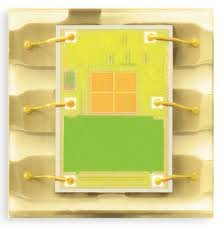
Called MAX44000 and made on a BiCMOS process, the 2x2x0.6mm IC includes three optical sensors and two ADCs.
Two of the photodiodes and an optical filter are used together to mimic the optical response of the human eye in a variety of spectral environments with a 0.03 to 65,535 lux dynamic range.
There are practical difficul¬ties in trying to reproduce the ideal photopic curve in a small cost-efficient package,” said Maxim. “The IC instead uses two different types of photodiodes, a green and an infrared, each of which is amplified and subtracted on-chip with suitable gain coefficients so that the most extreme light sources – fluo¬rescent and incandescent – are well matched to a com¬mercial luminance lux meter.”
Separate user-programmable green and IR chan¬nel gain trim registers allow the sensor to be used under dark or coloured glass.
Proximity detection uses the third photodiode, which is also infra-red, and an IR LED pulsed by the chip.
Pulsing cuts power consumption and allows the circuit to reject ambient illumination.
“When a smartphone is brought up to a user’s face, the touch screen must be shut off to prevent inadvertent touches that may disrupt the call,” said the firm. “Thus a proximity sensor is crucial. Once a sensed signal is received, it is run through a front-end circuit to reject ambient infra-red and sent to an ADC.”
For more read: Ambient light includes IR sensor for mobiles proximity detection
- What voltage range does the MAX44000 operate from?
The device operates from a VDD of 1.7V to 3.6V. - How much current does the MAX44000 consume in ambient mode?
It consumes just 5µA operating current when only the ambient light sensor is enabled. - Does the MAX44000 include an integrated IR LED driver?
Yes, it includes an integrated single-pulse IR LED driver with a programmable range of 10mA to 110mA. - What is the dynamic range of the on-chip ambient light sensor?
The sensor supports a wide dynamic range of 0.03 lux to 65,535 lux. - How does the device reject ambient illumination during proximity detection?
Pulsing the IR LED cuts power consumption and allows the circuit to reject ambient illumination. - Can the MAX44000 be used under dark or colored glass?
Yes, separate user-programmable green and IR channel gain trim registers allow usage under such conditions. - What type of package is the MAX44000 available in?
It comes in a tiny 2mm x 2mm x 0.6mm UTDFN-Opto Package. - Does the MAX44000 support communication via I²C?
All readings are available on an I²C communication bus.
