
Summary of TELEPRESENCE ROBOT FOR “DOING THE ROUNDS”
### Summary Will Donaldson from EDM Studio developed Omni, a modular telepresence robot designed for inspecting and maintaining remote devices where software tools fail. Built on a Raspberry Pi 4 running ROS2, the robot utilizes three omni-wheels for movement, a LIDAR sensor, a camera, an IMU, and an Arduino Nano for motor control. Its flexible chassis features machined mounting plates and supports attachments like a robotic arm, enabling it to perform hands-on tasks in environments similar to industrial inspection scenarios.
Parts used in Omni:
- Three omni-wheels
- DC geared motors with encoders
- Motor drivers
- Arduino Nano
- Raspberry Pi 4
- ROS2 (Robot Operating System)
- 360 LIDAR sensor
- High-quality camera module
- IMU (Inertial Measurement Unit)
- Threaded rods
- Machined plates with grid of holes
- Robotic arm
- Charging station connector with parallel metal strips
When you are responsible for maintaining devices at a client’s location, software tools like remote desktop and SSH are great, but sometimes they are not enough. For some problems, you need to get eyes and hands on the device to figure out what’s going on and fix the problem. This is a challenge [Will Donaldson] from EDM Studio is all too familiar with. They develop and maintain interactive museum exhibits all over the world, so they created Omni, a modular telepresence robot for inspection, maintenance, and a variety of other tasks.
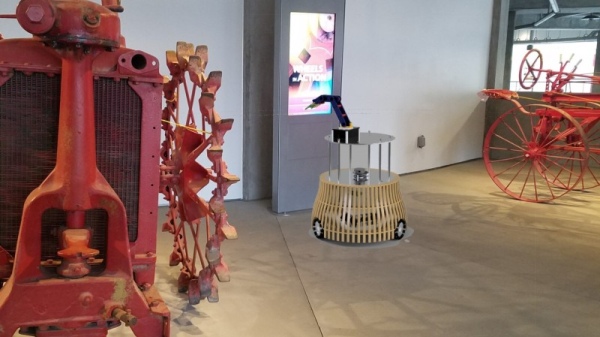
The Omni uses a set of three omni-wheels under its base, powered by DC geared motors with encoders, each controlled by a separate motor driver and Arduino Nano. A similar arrangement was used by Mark Rober for his domino art robot. The main controller is a Raspberry Pi 4 running ROS2 (Robot Operating System), which takes inputs from a 360 LIDAR sensor, high-quality camera module, and IMU.
All the components are mounted on a series of plates separated using threaded rods. This arrangement allows for maximum flexibility and space, especially the open-top plate, which has a grid of holes machined in to allow almost anything to be mounted. In this case, a robotic arm is mounted for manipulating the environment. Another neat feature is the charging station connector, consisting of two parallel metal strips on the outside of the robot.
Omni’s mission is very similar to that of Spot, the robotic dog from Boston Dynamics intended, among other things, for Industrial Inspection. What practical purposes would you use Omni for? Let us know in the comments below.
Source: TELEPRESENCE ROBOT FOR “DOING THE ROUNDS”
-
Why was the Omni robot created?
It was created because software tools like remote desktop and SSH are sometimes insufficient for fixing problems that require physical eyes and hands on a device. -
What system does the main controller run?
The main controller is a Raspberry Pi 4 running ROS2 (Robot Operating System). -
How does the Omni robot move?
It uses a set of three omni-wheels under its base, each powered by DC geared motors with encoders. -
Which components provide input to the main controller?
The inputs come from a 360 LIDAR sensor, a high-quality camera module, and an IMU. -
How is the flexibility of the chassis achieved?
Components are mounted on plates separated by threaded rods, featuring an open-top plate with a machined grid of holes for mounting various items. -
What practical task can be performed using the Omni's design?
A robotic arm can be mounted to manipulate the environment, allowing the robot to perform maintenance tasks. -
How does the Omni connect to its charging station?
It uses a connector consisting of two parallel metal strips located on the outside of the robot.
