
Summary of AUTOMATIC COIL WINDER GETS IT DONE WITH SIMPLE HARDWARE AND SOFTWARE
Parts used in the Automatic Coil Winder:
- PVC pipe and fittings
- Two drive motors
- Lead screw
- Arduino with CNC shield
- Spreadsheet software for G-code generation
- Wire spool form
We’ve grown to expect seeing mechatronics project incorporate a standard complement of components, things like stepper motors, Arduinos, lead screws, timing belts and pulleys, and aluminum extrusions. So when a project comes along that breaks that mold, even just a little, we sit up and take notice.
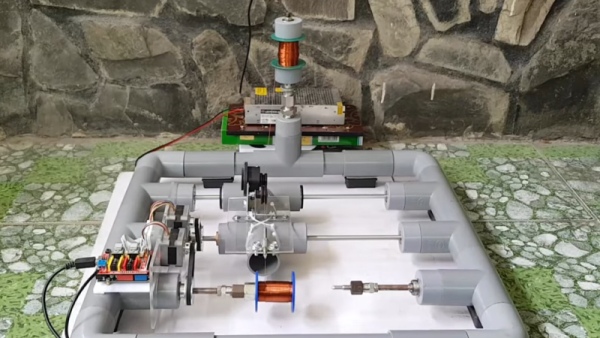
Departing somewhat from this hardware hacking lingua franca is [tuenhidiy]’s automatic coil winder, which instead of aluminum extrusions and 3D-printed connectors uses simple PVC pipe and fittings as a frame. Cheap, readily available, and easily worked, the PVC does a fine job here, and likely would on any project where forces are low and precision isn’t critical. The PVC frame holds two drive motors, one to wind the wire onto a form and one to drive a lead screw that moves the form back and forth. An Arduino with a CNC shield takes care of driving the motors, and the G-code needed to do so is generated by a simple spreadsheet that takes into account the number turns desired, the number of layers, the dimensions of the spool, and the diameters of the wire. The video below shows the machine going through its paces, with pretty neat and tidy results.
Being such a tedious task, this is far from the first coil winder we’ve seen. Some adhere to the standard design language, some take off in another direction entirely, but they’re all instructive and fun to watch in action.
Source: AUTOMATIC COIL WINDER GETS IT DONE WITH SIMPLE HARDWARE AND SOFTWARE
-
What materials are used for the frame instead of aluminum extrusions?
The project uses simple PVC pipe and fittings as a frame. -
How many drive motors does the machine use?
The machine holds two drive motors, one for winding wire and one for moving the lead screw. -
Can this design be used for high precision applications?
No, the PVC frame is suitable where forces are low and precision is not critical. -
What controls the motors in this build?
An Arduino with a CNC shield drives the motors. -
How is the required G-code generated?
G-code is generated by a simple spreadsheet taking input on turns, layers, spool dimensions, and wire diameter. -
Does the machine produce neat results?
Yes, the video shows the machine producing pretty neat and tidy results.
