
Summary of THE NEW BLYST840 PACKS A SURPRISING AMOUNT OF IOT HARDWARE INTO ITS TINY, FINGERTIP SIZE
BLYST840 is a fingertip-sized 14 x 9 x 1.6 mm ARM Cortex-M4F IoT module built on the Nordic nRF52832. It provides Bluetooth 5, Thread and Zigbee support, Micropython compatibility, 1 MB flash, 256 KB RAM, a 64 MHz processor, built-in antennae (Bluetooth and NFC), DC/DC converter/coils, crystals for low-power operation, an encryption coprocessor, on-board regulator (up to 5.5 V input) and 46 I/O pads—offering a compact, feature-rich system-on-module for ultra-low-power wireless applications.
Parts used in the BLYST840:
- Nordic nRF52832 Bluetooth SoC
- ARM Cortex-M4F 64 MHz processor (integrated in nRF52832)
- 1 MB flash memory
- 256 KB RAM
- Built-in ceramic Bluetooth antenna
- NFC antenna
- Encryption co-processor
- DC/DC converter
- Coils for low-power DC/DC mode
- 32 MHz crystal
- 32.768 MHz crystal
- On-board voltage regulator (accepts up to 5.5 V input)
- 46 I/O pads exposed around the module
BLYST Nano is a tiny ARM Cortex Module with Bluetooth and 30 I/O, but next product BLYST840 is a finger-tip size, 32-bit ARM Cortex-M4F module with Bluetooth 5 and 46 I/O; a powerful upgrade of a system on a module indeed.
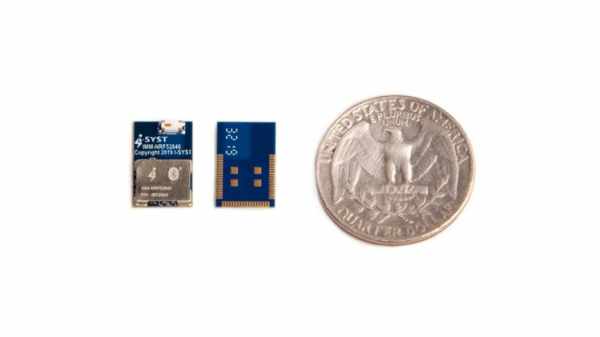
Built around the Nordic nRF52832 Bluetooth SOC and the powerful 64MHz ARM cortex- M4Fprocessor, the new BLYST840 from I-SYST can be described as an advanced and highly flexible chip solution to the rising demand in ULP wireless applications for IoT devices.
With dimensions smaller than a US quarter coin, the 14 x 9 x 1.6 mm BLYST840 packages everything an IoT device needs into a fingertip-sized module. The BLYST840 contains a CPU ( ARM Cortex-M4F), 46 I/O pins exposed to pads around the module for easy assembly, coils for low-power DC/DC mode, built-in ceramic antenna, encryption co-processor, NFC antenna, DC/DC converter, built-in 32 MHz and 32.768 MHz crystal for low power applications and requires no extra PCB space for supporting components. The BLYST840 also features an on-board regulator that accepts an input voltage of 5.5V and up to 25 mA for an external circuit.
While the BLYST840 maintained a lot of similarities with I-SYST last product, the BLYST Nano, it comes with several features that put it a few pedestals higher with 46 I/O pins, more wireless protocols like Thread and Zigbee added to the existing Bluetooth 5 support, and support for Micropython. The extensive availability of the memory (1MB flash and 256 KB RAM) together with the 32-bit ARM Cortex M4F running at 64 MHz also allows for quick and more efficient computation of complex functions.
Read more: THE NEW BLYST840 PACKS A SURPRISING AMOUNT OF IOT HARDWARE INTO ITS TINY, FINGERTIP SIZE
- What processor does the BLYST840 use?
The BLYST840 is built around a 32-bit ARM Cortex-M4F processor running at 64 MHz (part of the Nordic nRF52832). - How many I/O pins does the BLYST840 provide?
The module exposes 46 I/O pins to pads around the module. - Which wireless protocols are supported by the BLYST840?
The BLYST840 supports Bluetooth 5 and adds Thread and Zigbee protocols. - Does the BLYST840 include onboard antennae?
Yes, it includes a built-in ceramic Bluetooth antenna and an NFC antenna. - What memory is available on the BLYST840?
The module includes 1 MB flash and 256 KB RAM. - Can the BLYST840 run Micropython?
Yes, the BLYST840 supports Micropython. - What power components are integrated on the BLYST840?
It includes a DC/DC converter, coils for low-power DC/DC mode, crystals for low-power operation, and an on-board regulator accepting up to 5.5 V input and supplying up to 25 mA for an external circuit. - How small is the BLYST840?
The module measures 14 x 9 x 1.6 mm, smaller than a US quarter coin in diameter.
