
Summary of COIL ON PLUG IGNITION FOR TINY ENGINES
The spark plug enabled controlled combustion and higher revs in internal combustion engines. Roger Moore built a coil-on-plug ignition for a small single-cylinder model engine using an Arduino to time and charge a coil that fires the plug, with timing from a Hall effect sensor on the flywheel; future work aims to miniaturize the system for a V10 model.
Parts used in the Coil-on-Plug Ignition for Tiny Engines:
- Arduino
- Flyback transformer
- MOSFETs
- Passive components (resistors, capacitors, etc.)
- IGBT
- Capacitor (for energy storage)
- Coil mounted on top of the spark plug
- Hall effect sensor
- Magnet (mounted on the flywheel)
- Single-cylinder model engine (spark plug)
The spark plug was a key invention in the history of the internal combustion engine, allowing combustion to be easily controlled and engines to rev faster than messy earlier designs. Mid-century cars tended to rely on points ignition with a distributor and coil, however more modern designs place a coil on top of each individual spark plug. [Roger Moore] decided to build a similar setup for a small model engine on his workbench.
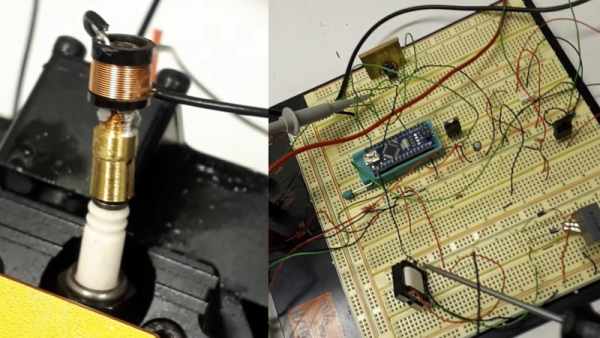
The rig is built with an Arduino, a flyback transformer, a smattering of MOSFETs and passives, an IGBT and a capacitor. The Arduino outputs PWM through a MOSFET which is stepped up through the transformer, and then charges the capacitor. The capacitor is then discharged into a coil mounted on top of the sparkplug of the single-cylinder engine, which fires the spark. The timing of the spark is determined by a Hall effect sensor reading a magnet placed on the flywheel.
Later development aims to shrink the system further to fit on a V10 design [Roger] is planning to make. It’s been done on a small scale before, and we’d love to see another tiny engine with way too many cylinders. Video after the break.
Source: COIL ON PLUG IGNITION FOR TINY ENGINES
- How is the spark generated in Roger Moore's setup?
The Arduino drives a MOSFET with PWM; the signal is stepped up by a flyback transformer to charge a capacitor, which is discharged into a coil on the spark plug to fire the spark. - What determines the timing of the spark?
Timing is determined by a Hall effect sensor reading a magnet placed on the flywheel. - What components are used to step up voltage?
A flyback transformer is used to step up the Arduino-driven signal. - How is energy stored before firing the coil?
A capacitor is charged and then discharged into the coil to produce the spark. - What switching devices are used in the circuit?
The rig uses MOSFETs and an IGBT for switching. - Is this system intended for multi-cylinder engines?
Roger plans to shrink the system to fit a V10 design in later development. - Was coil-on-plug ignition used in historical cars?
Mid-century cars used points ignition with a distributor and coil; more modern designs place a coil on top of each spark plug, which inspired this project. - What scale engine was this built for?
The setup was built for a small single-cylinder model engine on a workbench.
