
Summary of HOMEBUILT RACING SIM DOES ALMOST EVERYTHING FROM SCRATCH
This article details a DIY racing simulator rig built entirely from scrap materials by [Popicasa POPStuDio], avoiding commercial or 3D-printed parts. Version 1 utilizes PVC pipes, wood, and a smartphone for steering input, while Version 2 upgrades to an Arduino Leonardo, adds force feedback with a motor, and includes paddle shifters. Both iterations are constructed by hand using basic tools and repurposed components like gamepads and power switches.
Parts used in the Popicasa POPStuDio Racing Sim:
- PVC pipe
- Old wood
- USB gamepad
- Power switches
- Hot glue
- Flexible shaft
- Smartphone
- Arduino Leonardo
- Motor
- Belt drive
- H-shifter mechanism
- Paddle shifters
If you desire a sim gaming rig, there are off-the-shelf options up and down the market that stretch as high as your budget can afford. Some choose to eschew this route, however and build their own from scratch. Few people go quite so far as [Popicasa POPStuDio], however.
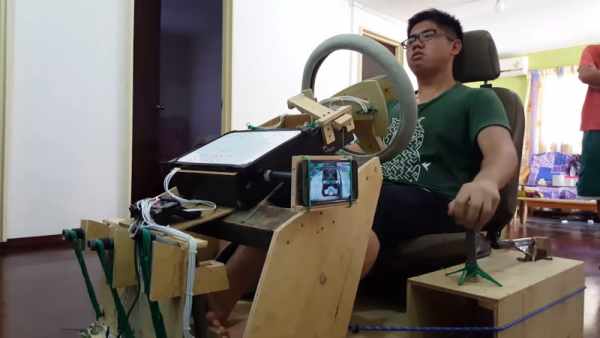
The first version of the rig is about as hacked as you can possibly get, and it’s a joy to see it built from scrap. The wheel itself and the pedals are all built out of old PVC pipe, with a bunch of old wood screwed together for the frame. A cheap USB gamepad serves to handle input to the PC for the pedals and H-shifter. The H-shifter uses simple power switches, repurposed in an ingenious way to sense gear position. The knob itself is cast out of what appears to be hot glue. Steering is done by connecting the wheel to a flexible shaft that tips a smartphone back and forth, using its internal accelerometers and gyros to sense rotation. It’s not clear how this is tied into the PC running Project CARS, but it’s impressive nonetheless.
Version 2 of the build takes things up a notch, using an Arduino Leonardo to handle steering and pedal functions as a Human Interface Device. There’s also force feedback, via a hefty motor attached to the steering shaft via a belt drive. This version implements an H-shifter as well as paddle shifters too for a more modern experience.
Both builds are unique in the modern era for eschewing CNC or 3D printed parts. It’s all done by hand, taking days of effort, and using only basic tools. It’s refreshing to see such a complex build done with nothing but simple materials and sheer commitment. We’re sure [Popicasa POPStuDio] enjoys the rig, and we can’t wait to see where it goes next. Perhaps the next iteration will even feature a motion platform, perhaps built out of old forklift parts? Only time will tell. Video after the break.
Source: HOMEBUILT RACING SIM DOES ALMOST EVERYTHING FROM SCRATCH
- What materials were used to build the first version of the rig?
The wheel and pedals were built from old PVC pipe, and the frame was made from old wood screwed together. - How does the steering system work in Version 1?
Steering connects the wheel to a flexible shaft that tips a smartphone back and forth to use its internal accelerometers and gyros. - Can you use off-the-shelf options instead of building from scratch?
Yes, there are off-the-shelf sim gaming rigs available that stretch as high as your budget can afford. - What component handles input for the pedals and H-shifter in the first build?
A cheap USB gamepad serves to handle input to the PC for the pedals and H-shifter. - How is gear position sensed in the H-shifter of the first version?
The H-shifter uses simple power switches repurposed in an ingenious way to sense gear position. - What upgrade distinguishes Version 2 of the build from Version 1?
Version 2 uses an Arduino Leonardo to handle functions and implements force feedback via a hefty motor attached via a belt drive. - Does the second version include modern shifting features?
Yes, the second version implements an H-shifter as well as paddle shifters for a more modern experience. - Are CNC or 3D printed parts used in these builds?
No, both builds eschew CNC or 3D printed parts and are done entirely by hand. - What tools are required to construct this simulator rig?
Only basic tools are used to construct the rig by hand over several days. - Could future iterations feature a motion platform?
The article suggests the next iteration might even feature a motion platform built out of old forklift parts.
