
Summary of WEMO SMART PLUG GETS BRAIN TRANSPLANT
This article details how [Gigawatts] replaced the proprietary controller in a Belkin Wemo smart plug with an Moteino board to prevent data leakage. The project involved removing the original control board and connecting the new microcontroller via the existing three-wire interface, which supplies 5V, ground, and a control signal. This modification allows the plug to operate without "phoning home" while retaining its core switching functionality.
Parts used in the Wemo Smart Plug Brain Transplant:
- Belkin Wemo smart plug
- Moteino (Arduino compatible board)
- RFM69 transceiver
- LED for status indication
- Relay board (high-voltage switching component)
- Original controller board (removed)
- Three wire connector
Like many modern smart home gadgets, Belkin’s Wemo brand of smart plugs has a tendency to phone home every time you turn on a lamp. [Gigawatts] wasn’t having it, so they figured out how to flash the device with OpenWRT and replicated its original functionality with a web interface. Unfortunately this stopped working after awhile, and rather than trying to diagnose the issue, it seemed the time would be better spent simplifying the whole thing.
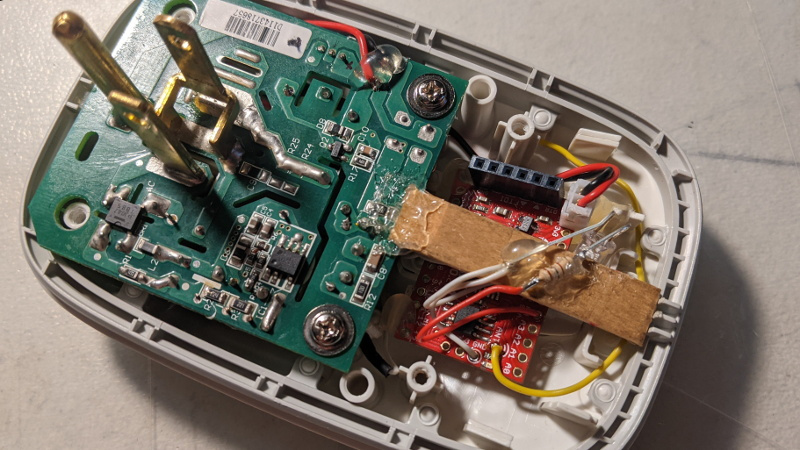
As [Gigawatts] explains, there are actually two separate boards inside the Wemo plug. One holds the relay to do the high-voltage switching, and the other provides the control. They are linked with a three wire connector, making it exceptionally simple to swap out the original controller for something different. The connector supplies 5 V and ground, all you’ve got to do is pull the third wire high to flick the switch.
While the ESP8266 probably would have been the first choice for many a Hackaday reader, [Gigawatts] actually went with the Moteino, a low-power Arduino compatible board with integrated RFM69 transceiver. With an LED to indicate status and a few lines of code tweaked, the Moteino got this once WiFi-only smart plug speaking a new language.
There’s some debate over how effective smart plugs are from an energy efficiency standpoint, but even if this reborn Wemo doesn’t help [Gigawatts] save much power, at least it won’t be blabbing about everything to a third-party.
Source: WEMO SMART PLUG GETS BRAIN TRANSPLANT
-
Why did the author replace the original controller?
The original device tended to phone home every time it was used, so the author wanted to stop it from sharing data with third parties. -
What is the internal structure of the Wemo plug?
There are two separate boards inside: one holding the relay for high-voltage switching and another providing the control functions. -
How are the two boards connected?
The boards are linked with a three wire connector that supplies 5 V and ground. -
Which microcontroller was chosen for this project?
The author chose the Moteino, a low-power Arduino compatible board with an integrated RFM69 transceiver. -
How does the new system trigger the switch?
You simply pull the third wire high to flick the switch. -
What feature indicates the status of the modified plug?
An LED was added to indicate the status of the device. -
Did the author consider using an ESP8266?
Yes, the ESP8266 would have been the first choice for many readers, but the Moteino was selected instead.
